Leo A dwarf irregular galaxy is a metal poor, gas rich, and one of the most isolated galaxies in the Local Group. Since stars have been forming recently in Leo A, its young stellar populations are still clustered. Investigation of star clusters may provide insight into conditions of their formation, because the fraction of gravitationally bound clusters is large in star-burst galaxies and small for quiescent star formation in low-density galaxies [1].
We have implemented an automatic method to identify stellar over-densities [2] for star cluster detection and applied it to Leo A galaxy. Star clusters can be resolved into individual stars with Hubble Space Telescope (HST) at the distance of Leo A, enabling us to perform stellar surface number density analysis.
By simulating star cluster observations, we have shown that such analysis is capable of finding clusters even in crowded stellar fields of the central part of the galaxy. We constrained detectability of clusters as a function of their age, mass, and size, and position in the galaxy.
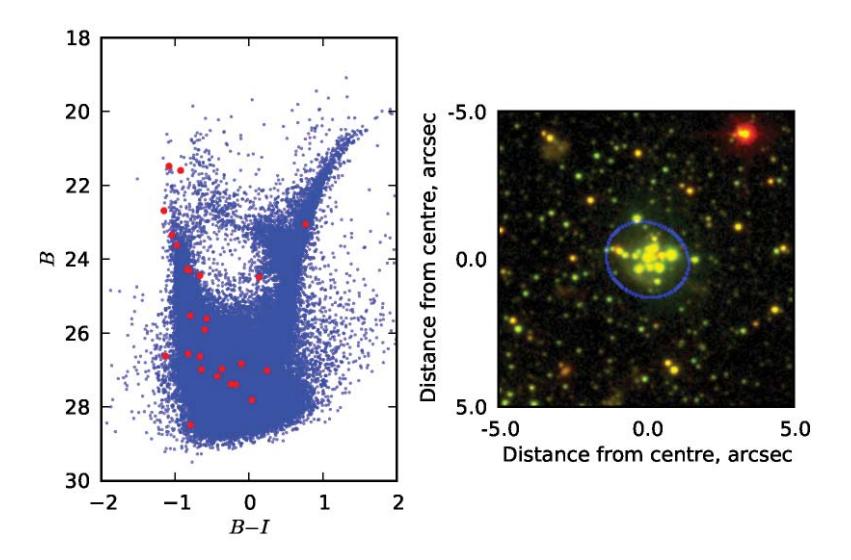
The method was applied on the HST Advanced Camera for Surveys observations [3] of the Leo A galaxy. Several star cluster candidates have been found (one of which is shown in Fig. 1). Physical parameters of star clusters have been derived in order to link their properties to the recent star formation event in the galaxy.