
Quantum dots (QDs) are extensively studied as promising materials for applications in various fields of medicine. QDs, also named luminescent semiconductor nanocrystals, are known for their unique photophysical properties, such as narrow size-dependent photoluminescence (PL) spectra, broad absorption spectra with large extinction coefficients, high PL quantum yields, exclusive photostability and ability to functionalize QD surface. It was suggested, that QDs could be used as energy donors for conventional photosensitizers (PS) in photodynamic therapy of cancer (PDT) – a treatment that uses light activatable drug and light of appropriate wavelength to damage cancer cells [1]. Singlet oxygen (1O2) is the main reactive intermediate involved in cancer cell killing during PDT. Thus, investigations of 1O2 generated by QD-PS complexes are important in order QDs could be used in PDT.
In this work we studied the production of 1O2 generated by CdSe/ZnS QDs (625 nm) and chlorin e6 (Ce6) PS complex QD-Ce6 in heavy water (D2O) solution. The formation of 1O2 was measured by detecting 1O2 luminescence at 1270 nm using near-infrared photomultiplier tube, cooled with liquid nitrogen. The samples were irradiated by continuous light source at 400 and 460 nm. The absorption of Ce6 at 460 nm is minimal, therefore 1O2 production by QD-Ce6 occurs only due to resonant energy transfer (FRET) from QD to bound Ce6. The results when the samples were irradiated at 400 nm, where Ce6 absorption is much higher, are also presented for comparison.
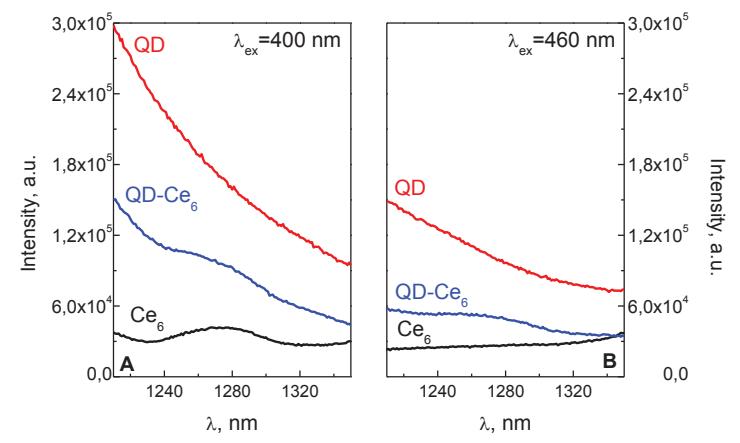
The variations in spectra of QD, Ce6 and QD-Ce6 in D2O indicated that QD and Ce6 forms a complex in D2O [2]. The spectral properties of QD, Ce6 and QD-Ce6 in D2O in spectral range of 1O2 luminescence, when the samples are irradiated at different wavelengths, are presented in fig. 1. The illumination of Ce6 at 400 nm as well as QD-Ce6 at both 400 nm and 460 nm resulted in a pronounced, though not intense, 1O2 luminescence signal at 1270 nm, indicating that 1O2 is produced. No 1O2 luminescence signal was detected in QD D2O solutions when illuminating the samples at 400 nm and 460 nm, nor in Ce6 D2O solution, irradiated by 460 nm light, resulting in no 1O2 in solutions.
Based on the experimental results we conclude, that QD-Ce6 complex is able to generate 1O2. The production of 1O2 occurs because of the resonant energy transfer from light absorbing QD to bound Ce6 molecules. Thus, QDs could be potentially used in PDT resulting in a more effective treatment.