
Coloured objects suffer from the light damage during exposure [1]. We trace that paper becomes yellowish, photographies lose their true colour and become dull, printed documents lose their contrast and could be hardly readable after prolonged exposition to the light [2]. Chromacity coordinates measurements show that aged and damaged inkjet colour print examples become a lot whiter and duller in colour. By incorporating light source composed of 623 nm red (R), 597 nm pc amber (A), 523 nm green (G) and 455 nm royal blue (B) light emitting diodes (LEDs) we are able to change various lighting parameters, such as colour rendering, correlated colour temperature (CCT), intensity [3] and make a suitable light source for a gamut and white point corrections.
Direct-emission LEDs usually have a very narrow spectrum (15-40 nm width at half maximum). As the band of LED spectrum becomes narrower, the colour saturation index (CSI) increases greatly [3]. Multicolour RAGB cluster helps to shift illuminated object colour coordinates to the saturated or dulled values and increase CCT. Practical example is shown (fig. 1) with 6500 K RGB cluster compared to a common 2950 K halogen lamp.
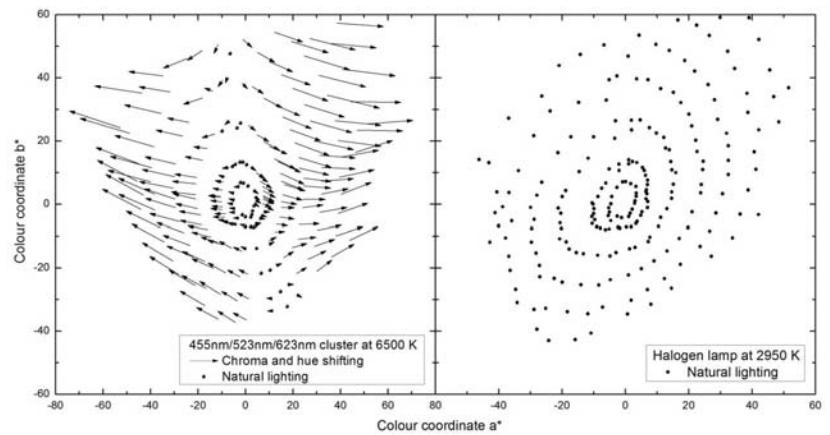
Ability to control illuminated surfaces chromatic saturation, allows restoring damaged objects colour gamut, shifting white point to a quasi-white light with lower yellow spectral component to decrease yellowish colours appearance. While changing spectral power distribution composition, photochemical damage index (DI) (1) is calculated and optimized to keep the lowest DI for the selected scene:
$$DI = \int_{300}^{780} \exp(-b(\lambda - 300))S(\lambda)d\lambda / \int_{380}^{780} V(\lambda)S(\lambda)d\lambda,\tag{1}$$Here b depends on an illuminated material. Solid-state lighting technology with multicolour LED clusters present a perfect light source with adjustable lighting parameters for the sensitive illuminated objects.