
Ferroelectric materials are of high interest for both researchers and engineers due to their remarkable properties. Their switchable electric polarization [1] is ideal for use in devices for memory storage and integrated microelectronics. Advanced devices tend to nanoscale, that raises necessity to research new cheaper and more durable materials.
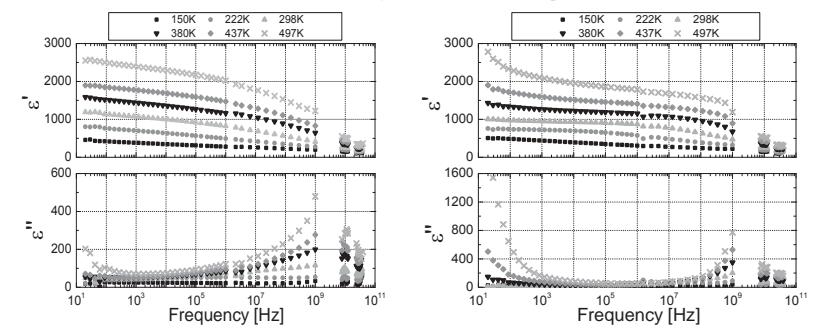
BSPT (xBiScO3-(1-x) PbTiO3) x=0.36 and 0.375 ceramics with micron, submicron and nanoscale grains were produced from nanocrystalline powders obtained by mechanosynthesis [2] in different milling media. In figure 1 we can see that ceramics made with stainless steel milling media have higher dielectric permittivity at low frequencies compared to ones produced with WC milling media. WC-milled ceramics also exhibit a more narrow dispersion region, however dielectric permittivity decreases more rapidly at high frequencies (106-109 Hz) in this case. Both ceramics have similar dielectric properties in microwave region (10 – 40 GHz).