
Reduction of water flow friction by applying electric potential to the pipe wall [1] can contribute to the ability to actively manipulate a wall-bounded liquid flow field to effect a desired change. This effect has been tested in two Norwegian hydroelectric power stations [2]. However, the mechanism of this effect is not clear yet.
Computer controlled fluid circulation system for measuring the drag force of the body, whose electrode potential can be controlled independently, was built. By using this technique the potential dependence of the drag force on a gold coated sphere was measured in a stream of 0.01 M sodium hexafluorophosphate (98%, Sigma-Aldrich) solution prepared in distilled water. Hexafluorophosphate was chosen in order to compare the results, obtained in present work, with those obtained by using piezoelectric sensor [3]. The averaged drag force values were assigned to the flow velocities and potential intervals, at which they were measured. Then the drag coefficients were calculated for the sphere via Eq. (1) and were corrected for the wall effect [4].
$$C_D = 8F_D/(\pi\rho v^2 d^2) \tag{1}$$The LOESS (local smoothing technique with tri-cube weighting and polynomial regression) procedure was used to smooth the drag force data as a function of the potential. The Loess fits for gold coated sphere drag versus potential are shown in Fig. 1.The sampling proportion was chosen to be 0.4 since this produced a good tradeoff between noisy undersmoothing and oversmoothing which misses some of the peak-and-valley details in the data.
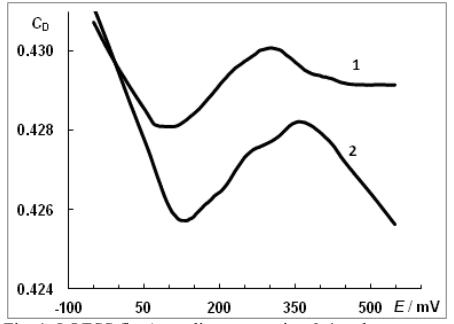
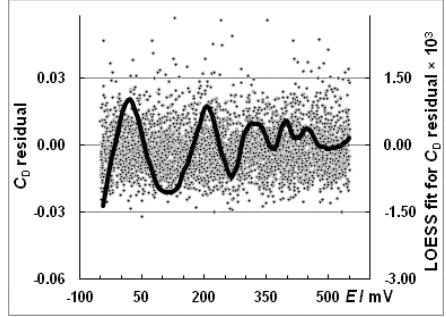
To gain insight in goodness of LOESS fits in Fig. 1, the residuals of these fits are plotted versus the potential (Fig. 2), where again the LOESS smoothing technique is used to smooth the drag coefficient residuals as a function of potential. The character of interfacial viscosity change with potential is similar to the potential dependence of drag coefficient (Fig. 1) and correlates with the dependence of interfacial viscosity on the potential, which was obtained by using dual-quartz resonator (two resonators with differently textured surfaces in a monolithic sensor).
The results obtained increase the ability to actively manipulate a wall-bounded liquid flow field to effect a desired change what is of great technological importance.