
Automated and accurate sample temperature control is very important for the measurements of electrical properties of solid state materials. Therefore an automated temperature control system is required that can effectively control a small heater with low thermal inertia, accurately measure sample temperature and provide rich functionality for measurement automation and ease integration to other systems. During this work such system was built for use in a broad band impedance spectrometer [1], four electrode impedance spectrometer for investigation of solid ion conductors [2] and other similar measurement systems. Temperature controller was built using standard laboratory equipment and personal computer with MATLAB computing environment.
The hardware part of temperature control system is shown on Fig 1. It consists of a resistive sample heater, a computer controlled Agilent E3634A linear power supply unit, an Amprobe TMD90A digital thermometer with a K type thermocouple for sample temperature measurement and a computer with MATLAB computing environment together with required hardware interfaces.
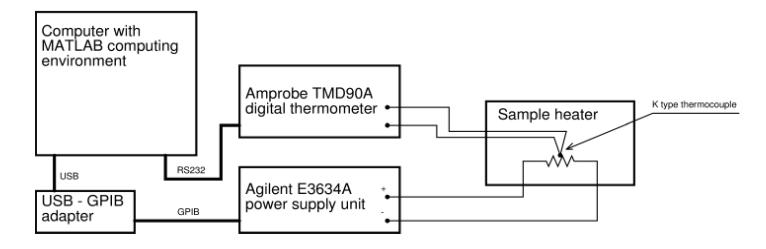
The heart of this controller is a software program written in MATLAB programing language. This program controls temperature according to a given curve, allows temperature stabilization and measurement triggering at certain points. It also provides temperature versus time curve monitoring tools.
For temperature control, custom closed-loop PID (proportional-integral-differential)[1] algorithm is used. The PID algorithm coefficients and heater temperature versus voltage relation is determined by automated calibration function. This prevents system instability and provides fast and accurate temperature control without manual system tuning. Some error detection mechanisms are also implemented to ensure save system operation without constant supervision.
The temperature controller program was designed using object oriented programing paradigm. This program consists of the two hardware dependent classes, the main controller class, and the graphical user interface (GUI) class. The hardware dependent classes provide separate methods for data acquisition from the digital thermometer and power supply unit control, thus separating hardware dependent program code from rest of the program. Main controller class provides methods for external system control from other programs and implements temperature control and calibration algorithms. GUI class provides all required controls and parameter monitoring tools.
This temperature control system can be used for various applications. Program modularity and automated calibration function allows easy adaptation to different hardware. Control accuracy and other limitations mostly depend on the equipment used. Using the above mentioned equipment 0.2K temperature control accuracy was achieved in the temperature range 300K – 1200K. System was stable at lower then 5 K/min rates of temperature change.