
It is known since the early examinations of solid-state luminaires in street lighting applications that one day light-emitting diode (LED) based lamps will replace high pressure sodium (HPS) ones. Today LED based lamps does not offer significantly higher energy efficiency compared to HPS, although, solid-state light sources has unique properties, such as instantaneous and efficient dimming, improved flux directionality and variable spectral power distribution. Also intelligent control can be adapted using pedestrian movement detection, light sensors and weather monitoring, since wet or snowy surfaces are up to three times more luminous than dry ones [1]. These are the key features highly increasing solid-state street lighting energy savings today.
Although solid-state street lighting and dynamic control realization would require huge investment to new data and power lines infrastructures. We offer autonomous intelligent street lighting controller which does not require any infrastructure modifications.
Controller has inputs for external movement sensors, up to four independent outputs for luminaire intensity control and programmable calendar for custom date and time dependent street illumination.
Module is compatible with internal luminaire DC power source. Controller does not require constant power source or synchronization since global positioning system's (GPS) receiver is used for automatic and exact time synchronization from satellites.
Module's settings are configured via custom made JAVA based user interface. Using this software time and date dependent street lighting protocols are configured. There is ability to set different lighting regimes for every day of the week separately and additionally up to 20 custom holidays. Each day can be programmed up to four different light intensity modes. When all required data is uploaded controller can work autonomously.
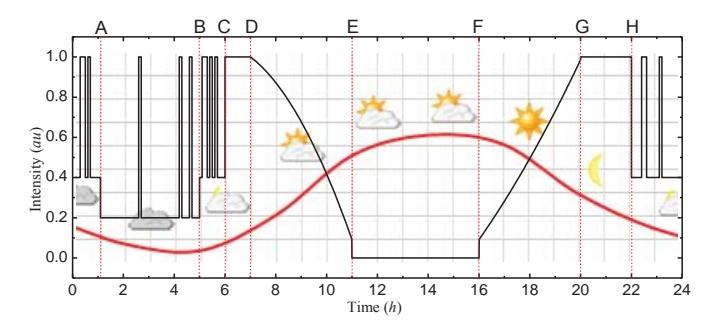
One day module's work cycle is depicted in figure 1. In example from A to B constant illumination level is set to 20%. Spikes in intensity chart shows triggered movement detectors. From D to E constant surface illumination level is maintained with respect to road luminance measurement.
By employing intelligent street lighting module it is expected to achieve up to five times reduced total energy consumption for streets illumination.