Optical parametric oscillators (OPO) pumped by femtosecond laser pulses are universal devices providing tunable radiation in a wide spectral range. Such radiation is used for investigation of various ultrafast processes in biochemistry, photochemistry, spectroscopy, etc. In order to achieve parametric generation of high repetition rate low energy picosecond or femtosecond pulses synchronous pumping must be used. Synchronous pumping technique involves such OPO cavity adjustment that the time required for the generated pulse to complete one round trip in the cavity is inversely proportional to the repetition rate of pump pulses.
During parametric generation process pump radiation is converted into two lower frequency parametric waves called signal and idler. Generated wavelengths are defined by the conservation of energy and momentum [1], also known as the phase matching conditions, which can be used to calculate the wavelengths of generated waves (Eq. (1), Eq. (2)).
$$ \omega_p = \omega_s + \omega_i \tag{1} $$ $$\frac{1}{\lambda_p} = \frac{1}{\lambda_s} + \frac{1}{\lambda_i} \tag{2} $$Today, most of the commercially available SPOPOs are pumped by fundamental or second harmonic radiation of Ti:sapphire laser. During past few years the great breakthrough of Yb:KGW laser systems was observed. The use of Yb:KGW laser as a pump source for SPOPO might lead to cheaper and more compact high repetition rate tunable light source.
In our study, we used second harmonic radiation (515 nm) of a femtosecond “Pharos” oscillator providing 105 fs pulses at 76 MHz repetition rate with the average output power of 4 W at fundamental (1030 nm) wavelength. Furthermore, in order to implement parametric generation, a nonlinear medium is required. In our SPOPO we used a $\beta$-barium borate (BBO) crystal (5x5x2 mm) cut for type-I interaction at $\theta=22.2^{\circ}$, $\varphi=90^{\circ}$ angles and coated with anti-reflective (AR) coating for pump (515 nm) and parametric (630-1030 nm) radiation. We used a singly resonant oscillator [2] thus mirrors were highly reflecting at only one of the parametric waves (the signal wave in our case).
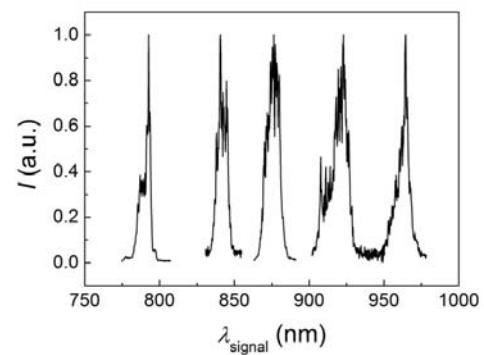
Wavelength tuning can be achieved by rotation of nonlinear crystal or by changing the length of SPOPO cavity. When the cavity length is tuned, synchronous pumping condition is satisfied for a different wavelength. As seen in Fig. (1), we achieved signal wave tuning in a 760-980 nm range. We have also measured the output powers at different signal wavelengths and determined generation thresholds. Moreover, a dependence of signal wavelength on resonator length increment was measured.