
The recent sharp progress of III-nitride based devices caused a growing interest in aluminum-rich AlGaN layers and quantum well structures growing technology, optical and electrical properties. It is difficult to grow and characterize high Al mole fraction AlxGa1-xN compounds, due to inevitably forming dislocations [1] during the growing process and significantly wider energy gap compared to GaN [2], but the latter ternary materials are irreplaceable in deep ultraviolet applications. After research group of IPR (Institute of Applied Research) started to grow AlGaN layers using MOCVD technique, it has become necessary to characterize the later layers for further quality improvement of the compounds. In this work I investigated nonequilibrium carrier dynamics in various aluminum content AlGaN layers and their dependencies on growing conditions.
This study was performed using optical Transient Gratings (TG) experimental technique. In the studies I used picosecond pump-probe setup, designed to measure light-induced refractive index ($\Delta n$) change dynamics over a wide excitation energy (0.05 – 1 mJ/cm2) range. Nonequilibrium carrier lifetime and diffusion coefficient were determined from the diffraction signal kinetics.
In this study, 15 AlGaN layers with different molar concentrations of Al (17, 22, 41%) were grown by Metallorganic Chemical Vapour Deposition (MOCVD) on sapphire (Al2O3) substrates under different ammonia (NH3) flows, and were excited with short-wavelength (263 nm) coherent light beams.
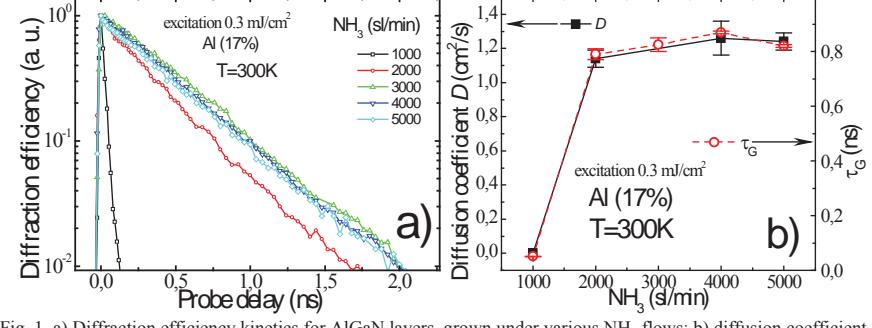
TG measurements showed that decay transients of TG signal are exponential for low Al content (17 and 22%) AlGaN layers (Fig. 1. a)), and reflects linear free carrier recombination through defective levels (Shockley-Read-Hall recombination). Whereas for high Al molar concentration (41%) AlGaN compounds research revealed additional physical mechanisms, that are influenced by the chaotic structure of the samples: square bimolecular recombination and/or localized carriers delocalisation. The latter processes contribution to the kinetics non-linearity will be determined from the PL and temperature TG measurements.
The estimated lifetime of free carriers at the same NH3 flow significantly decreases with increasing Al content (from 790 to 420 ps). Determined AlGaN layers free carrier lifetime dependencies from ammonia flow revealed a general regularity for the compounds series of different Al content – flow Increase leads to a significant layer quality improvement (recombination time increases from 41 to 685 ps for 22% AlGaN layers, while NH3 flow varies within 500 –2500 sl/min range). The latter dependencies have nonequilibrium carrier lifetime maximum or saturation at different NH3 flow values for different Al content layers, and strongly correlate with the diffusion coefficients (Fig. 1. b)). Estimated nonequilibrium carrier lifetime ($\tau_R$) and diffusion coefficient (D) dependencies on the excitation power density (J) showed that $\tau_R$ and D increases with J. After further PL and TG measurements and confirmed assumption of strong localization influence to carriers dynamics, the latter dependencies could be interpreted as defective states saturation and the excitation activated diffusion models.