
Recent tendencies in imaging research show an active interest in terahertz (THz) radiation. Ability of THz radiation to propagrate though clothing or common packaging materials makes it perfect for purposes of security. One of the key points in implementing THz imaging systems is having sensitive and reliable sensors, that are capable of working at rooms temperatures. At the moment, three main types of sensors are used: so called bow-tie diodes, that use electrons heated in non-uniform electric field, microbolometers and field-effect transistors with two-dimensional electron gas (2DEG)
Transistor approach was found to be an effective solution for detection of radiation [1]. Detection mechanism relies on 2DEG under the gate of transistor. Under certain conditions it acts similarly to shallow water and has resonant properties. What is even more useful – detection frequency depends on working parameters of transistor. By changing parameters one can change its mode as it can work either as a wide, either as a narrow spectrum detector.
Investigation of noise characteristics under varying parameters (like temperature) allows to determine certain processes inside of the sensor as well as to reveal the main sources of fluctuations [2].
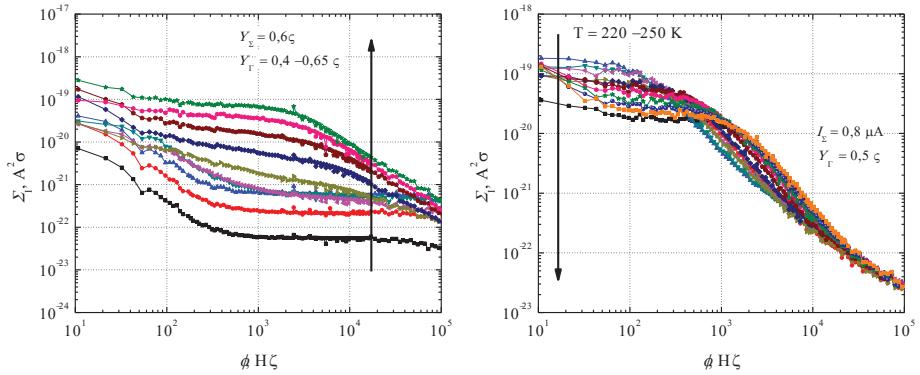
Matrix of 5x10 transistors with varying channel lengths and widths was investigated. Even at room temperature Lorentzian type spectra prevailed typical 1/f type spectra for all measured examples (Fig. 1). Changing lattice temperature, while maintaining constant current (Fig. 2) yielded activation energies of approximately 0.2 eV. These results allows to assume, that noise if generated by generation and recombination processes in the defects of the structure