Depending on application, requirements for light sources are different and for each particular use light sources have to be optimized. Therefore they must have several important parameters, for example, high intensity of spectral lines, emission stability in time, long life-time etc. High-frequency electrodeless lamps (HFEDL) are widely used as bright radiators of narrow and intense spectral lines in different types of scientific devices, for instance, in atomic absorption spectrometers. Depending on HFEDL filling and operating mode, it is possible to observe the self-modulation regime. For optimization of light sources it is important to understand processes in plasma, including self-modulation mode.
HFEDL under study was filled with Selenium and Argon mixture (pressure 1 Torr). This type of lamp is manufactured at the Institute of Atomic Physics and Spectroscopy, University of Latvia. The spherical lamp vessel with diameter of 1 cm is made of SiO2 and filled with working element and buffer gas. An inductively coupled discharge is induced by placing lamp in a high frequency generator coil. The frequency of electromagnetic field is about 100 MHz.
The emission spectra of the discharge was registered by means of JobinYvon SPEX 1000M high resolution spectrometer (grating 1200 1·mm-1) and charge coupled device matrix detector (2048x512 Thermoelectric Front Illuminated UV Sensitive CCD Detector, Simphony). AVANTES AVS-PC2000 plug-in spectrometer with a 2048-element linear CCD-array detector (wavelength range 190 – 850 nm) was used for intensity stability measurements.
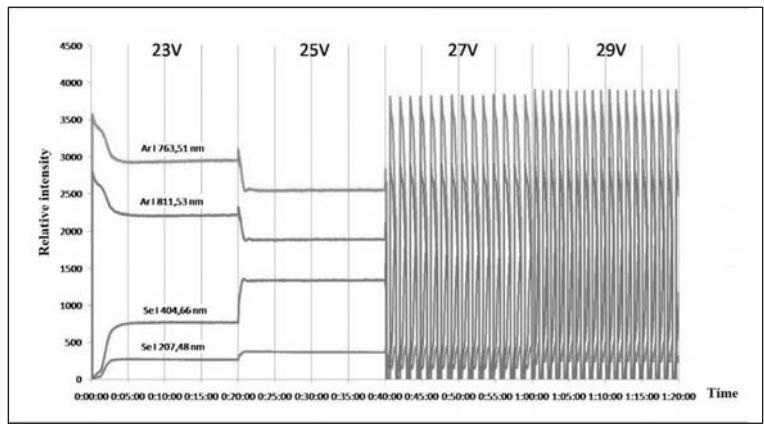
HFEDL was operated at different excitation generator voltage values (21–29V), and the emission spectra changes were analyzed (Fig. 1). In emission spectra of Se + Ar HFEDL bands of different molecules could be observed, for example, OH, C2, CN and Se2. Previous measurement results show that OH rotational spectra at 310 nm can be successfully used for estimation of gas temperature in HFEDL.
Intensity stability of Se + Ar HFEDL in dependence on excitation generator voltage was measured. These measurements showed that lamp stabilize within 1–2 minutes, however at higher values of applied voltage it is possible to observe self-modulation regime (Fig. 1.). The behavior of different atomic lines (Se, Ar) and molecular bands (Se2, OH) in self-modulation mode was studied. During the self-modulation regime first we observe intense discharge in buffer gas (argon), then due to the increase of gas temperature, the intensity of Se lines grow rapidly until the discharge goes into its minimum phase. After the cooling period (minimum phase) the discharge in buffer gas starts again. In maximum intensity phase estimated gas temperature is about 1000 K, at applied voltage 29 V.