
Optical coatings are thin solid films on surfaces of optical substrates which change their optical properties. Today these layers can be prepared by various deposition techniques. However main problems of optical properties are related to their structural properties (in homogeneity, stress, defects and roughness of the surface). Thin film optical coatings made by ion beam sputter (IBS) deposition have great optical properties such as high refractive index, low absorption, and low scattering [1]. Even so present day applications require higher performance coatings such as those employed in high power lasers and laser gyroscopes where reflectance and stability are important factors [2]. Mixed composition films show modification of structure and better optical properties. Composite thin films consisting of the mixture of two or more materials have a wide range of applications. Mixtures with adjustable refractive index are important in the preparation of many optical devices such as Rugate filters, Notch filters and integrated optical waveguides. Also, knowing the compositional dependence of the absorption edge is necessary to define the spectral range where mixtures are transparent and thus useful for optical coatings in which absorption must be avoided.
In this work 0%, 25 %, 50 %, 75% and 100 % hafnia fraction HfO2 - SiO2 mixtures films were fabricated by IBS technology using argon ions to sputter materials from Hf/SiO2 target. Each film thickness - 6 QWOT at 355 nm wavelength were deposited. Refractive index (Fig. 1) and extinction coefficient dispersions (Fig. 2) of materials with different volumetric fractions in coatings were analyzed using spectrophotometric data. The X-ray photoelectron spectroscopy (XPS) method was used to obtain the information about the chemical composition and atomic fractions of the coatings. The structure has been evaluated through X-ray diffraction (XRD) and the surface roughness - through atomic force microscope (AFM) data. The profilometry measurements has been applied also to evaluate the stress of mixtures.
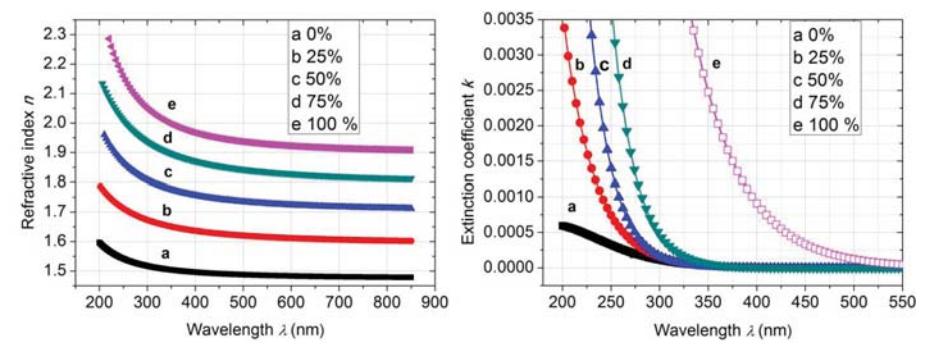
It was been shown, that use of mixtures decrease extinction coefficients. Refractive index n evenly dependent of HfO2 fraction in contrast to the k. It should be noted, that use of mixtures decrease stress. Additionally ex-situ annealing process also reduce residual stress and extinction. Investigated characteristics of deposited mixtures was used to design a high reflectivity mirrors for 355 nm wavelength.