
Solid oxide fuel cells are an attractive power generation technology thanks to their extremely high efficiency, fuel flexibility and low environmental impact. Despite these advantages, operating temperatures in excess of 800 °C are required to achieve efficient operation in current commercial products due to the use of doped ZrO2 based electrolytes. This necessitates the use of expensive sealant and structural materials for manufacture of fuel cell stacks, making the final product too expensive for widespread adoption. Current research in the area is mainly concerned with fuel cell operating temperature reduction to the intermediate range of 600 °C to 800 °C, which can be achieved using various doped CeO2 based electrolytes. Disadvantages of these materials include higher electronic conductivities, as compared to doped ZrO2, and the ability to be significantly reduced in the conditions present on the anode side of the fuel cell, making the material unusable as an electrolyte. In this work we present a study of 20 mol. % Gd2O3 doped CeO2 (GDC) electronic conductivity as it depends on oxygen activity over a temperature range of 600 °C to 750 °C.
The measurements were carried out using a modified Hebb-Wagner method, based on the analysis of steady state polarization curves around an ion-blocking microcontact. [1] Due to a slight deviation from stoichiometry present in the oxide, oxygen activity at the blocking electrode can be controlled by applying different DC voltages across the measurement cell. The oxygen activity at the other side of the pellet must be held constant by a reversible electrode, which is conductive to both, oxygen ions and electrons. To ensure fully blocking behavior of the microelectrode, the measurements were carried out in dry N2 atmosphere using Platinum as the electrode material. The sample and electrode interface was encapsulated using a glass-based sealant. A 1:1 charge ratio mix of CuO and Cu2O was pressed into pellets and sintered in inert atmosphere to be used as a reversible electrode and known oxygen activity reference.
The solid electrolyte pellets were prepared from commercial (Fuel Cell Materials) GDC nanopowder (grain size < 10 nm) with a surface area of 220 m2/g. X-ray diffraction and thermogravimetry was performed on the powder to determine the presence of impurities. The powder was heat treated to remove any adsorbed water, as well as other unwanted volatile compounds, before being isostatically pressed at 5000 bar and sintered at 1400 °C for 1h, losing its nanoscale character.
Electronic conductivity results at 750 °C, typical of the material at all temperatures, are shown in the figure below.
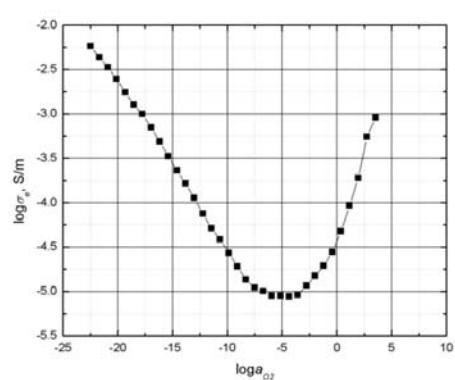
Two distinct regions in the graph are visible, corresponding to electron conductivity at low oxygen activities and hole conductivity in the high oxygen activity range. The electrolytic domain, where no significant electronic transport is possible lies in the intermediate oxygen activity range, leading to the conclusion that this material is best suitable for use as an electrolyte in single-chamber SOFCs, which operate at intermediate oxygen partial pressures, and as a component of multi-phase metal-ceramic electrodes for conventional fuel cells, where electronic conductivity is desirable.