The probability of an atom excitation during a collision with an electron is defined by the collision cross section. Cross sections are important in modelling various processes occurring in plasma physics. However, their experimental values still possess a high degree of uncertainty, therefore imposing a need of theoretical data.
In the Department of the Theory of Atom of ITPA VU, the programs for calculating excitation cross sections exploring various wavefunction bases using Born approximation have been developed. To evaluate the performance of these programs, several light atoms (H, He and Li) were chosen, all of whom have broad and verified data in NIST database [1]. Two radial orbital bases were chosen for calculations, non-relativistic (HF) and quasirelativistic (QR) one. In case of helium and lithium, correlation effects were taken into account by using the transformed radial orbital method [2,3]. However, since the main cross section data from NIST [4] was additionally scaled, the same scaling procedure was performed in our calculations. The one-configuration Dirac-Fock method (DF) was applied in [4], therefore their results were scaled using the experimental values of oscillator strengths. However, in our work, a multi-configuration method is used, requiring no additional scaling. The programs calculated cross sections for excitations to any level, so our calculation data had to be summed in order to get the results analogous to those in NIST databases.
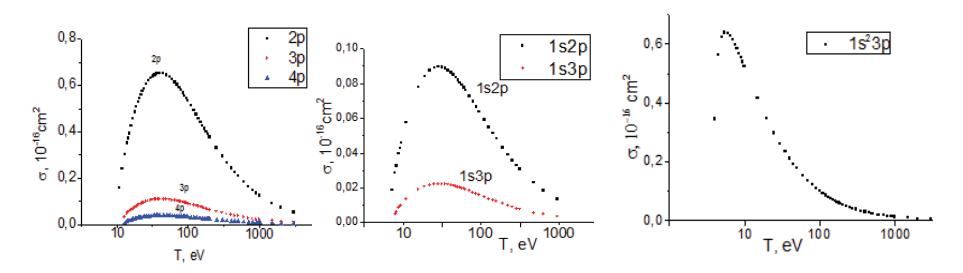
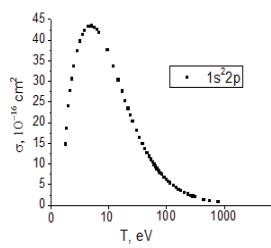
We see a very close agreement with the data from [4] in almost every case. For our cross sections, the relative mean square deviations are: hydrogen - $1s\rightarrow 2p$ 0,22% (HF) and 0,22% (QR), $1s\rightarrow 3p$ 0,22% (HF) and 0,22% (QR), $1s\rightarrow 4p$ 0,21% (HF) and 0,22% (QR); helium - $1s^{2}\rightarrow 1s2p$ 1,52% (HF) and 1,59% (QR), $1s^{2}\rightarrow 1s3p$ 9,94% (HF) and 0,74% (QR); lithium - $1s^{2}2s\rightarrow 1s^{2}2p$ 2,11% (HF) and 1,76% (QR), $1s^{2}2s\rightarrow 1s^{2}3p$ 34,17% (HF) and 34,47% (QR). The atoms under consideration have small nuclear charges, therefore the HF and QR results are very close to each other. But the QR results agree with those from [4] even better. Most likely, this agreement occurs because the DF relativistic functions were used in [4]. Our results agree better with those from [4] than any other author's results given in [1]. The only major difference appears in lithium $1s^{2}2s\rightarrow 1s^{2}3p$ excitation. Currently, it is difficult to determine which results are more accurate because no other theoretical or experimental data are available. These discrepancies may only be eliminated with additional investigation. The dependence of excitation cross sections on the energy of incident electron is given in Figures 1-4.
Overall results indicate that the methods and programs in use are suitable and accurate to produce reliable data for electron-impact excitation of light atoms.