
Carbazole and fluorene are perspective materials for application in organic blue light - emitting diodes (OLED) considering their high fluorescence quantum emission efficiency and good electrical properties. By combining carbazole and fluorene elements, larger multifunctional molecular compounds with better optical and electronic properties could be produced. Moreover, the thermal stability and glassy state durability of these organic molecules were found to be significantly improved upon incorporation of a carbazole and fluorene moiety in the structure [1].
In this work photophysical properties of a set of tetrameric carbazole and fluorene derivatives (Fig. 1 AM-114, AM-124, AM-138) were investigated. Their optical properties were compared with trimeric and dimeric compounds of similar molecular structure.
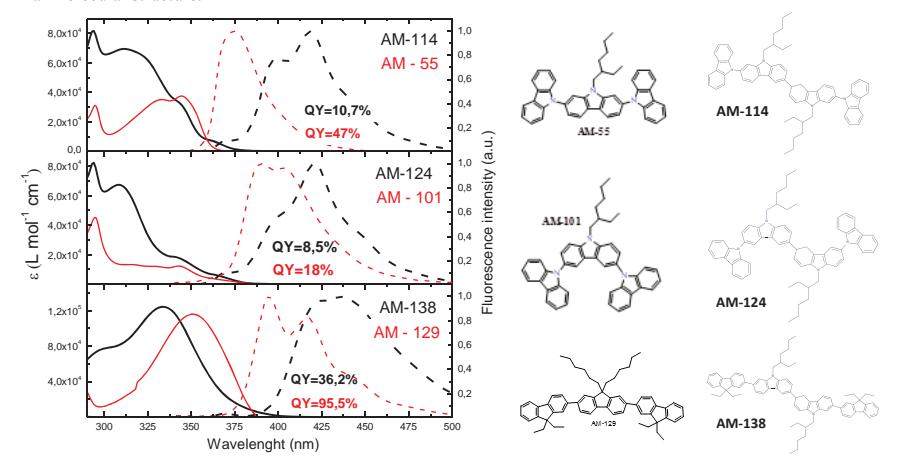
Spectroscopic analysis of novel carbazole and fluorene derivatives showed that elongated $\pi$-electron conjugation caused significant red shift of absorbance and fluorescence bands compared to trimeric compounds (Fig. 1). Fluorescence quantum yield (QY) was found to be lower (from 8% to 40%) for tetrameric compounds in dilute solutions. Comparable fluorescence spectra and low QY values could be influenced by emission from central 3,3'-bicarbazole structure. However introduction of fluorene moiety enhanced QY both in dilute solution and solid state. A reduction of QY in thin films (from 1,8% to 8%) was observed due to close molecular packing.
Relatively high fluorescence decay times (${\tau}_{AM-114}$=6,5 ns, ${\tau}_{AM-124}$=6,8 ns, ${\tau}_{AM-129}$=5.21 ns) and low fluorescence quantum yields resulted in higher non-radiative recombination rate in respect of radiative rate. Fluorescence decay transients in the solid state exhibited the non – exponential behavior implying the existence of few molecular conformation states in excited state.
Although tetrameric carbazole and fluorene molecules did not exhibit fine optical properties for application as blue-light emitter, strong excitonic coupling in solid state shows tight molecular packing and, thus possibility to use the materials as charge transfer layers. This is in line with pronounced hole mobility values of 10-3 cm2/Vs obtained by xerographic time-of-flight technique.