
For a long time it was not possible to measure higher-order aberrations in the human eye, but since the Shack-Hartmann sensor was fitted for vision science it became possible to make objective, accurate and fast measurements of wave aberrations. Dependence of numerous visual functions on ocular aberrations has been studied [1, 2]. The aim of the research is to study influence of optical aberrations induced in one eye and the accommodative response in the fellow eye. As aberrations affect depth of focus, it is likely that they also play a role in the fluctuations of accommodation [2] and hence contribute to changes of refractive errors throughout the life.
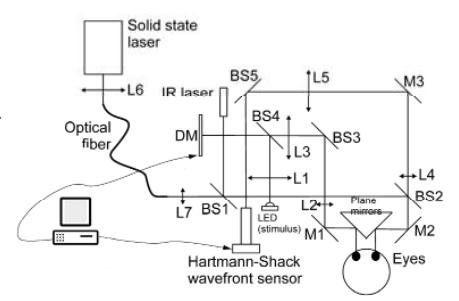
A custom Hartmann-Shack and adaptive optics setup was built to generate and measure wave aberrations. The optical setup is shown in Figure 1. Accommodative response was estimated from wave aberrations for different patterns of aberrations which were induced by an unimorph quartz based deformable mirror. The deformable mirror consists of 24 individual segments. The Hartmann-Shack sensor used has 512 x 512 pixels large CCD matrix. The deformable mirror, Hartmann-Shack wavefront sensor and pupil of the eye were located in the conjugate planes. Measurements were obtained without cycloplegia under natural conditions.
When different patterns of optical aberrations are induced in one eye small changes in accommodation are occurring in the fellow eye. The area in the brain responsible for control of accommodation receives two separate inputs from the both eyes and choose the smaller amount of accommodation required. However, it seems that accommodation of one eye doesn't depend strongly on the image quality in the fellow eye. The order of changes of accommodation in the fellow eye are few hundredths of a μm. Hypothesis is that lower order aberrations influence accommodation in the fellow eye more than higher order aberrations.