
Solar simulators are devices providing illumination, which similar to the natural sunlight in standardized conditions. Their purpose is to provide a possibility of controllable indoor test for evaluation of solar cells and modules. Most usually, so-called AM1.5 conditions for the Solar spectrum are simulated. Several types of light sources are used for solar simulators. For examples, xenon arc lamps are the most common source today due to a reasonably good match of the spectrum. However, a quite complex optical system is required to ensure an even illumination at the test plane, which leads also to low energy efficiency of test systems. Quartz tungsten halogen (QTH) lamps offer an alternative; however, their lower color temperature leads to difficulties in filtering out the excessive long wavelength components. Recently, 1.5 W light emitting diodes (LEDs) were already applied to simulate solar radiation with 90% of the required by the standard intensity [1]. In addition, hybrid LED and halogen lamp source with B class spectral match was also demonstrated [2].
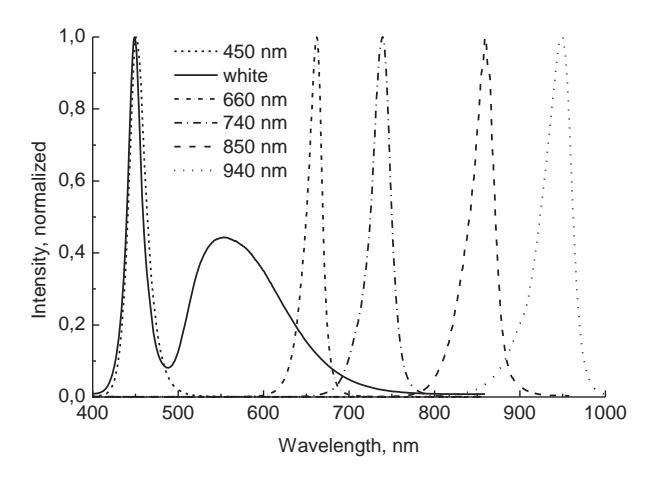
In this contribution, we report on the evaluation of high power LEDs for application in solar simulators. Distributions of radiant flux were investigated at various distances using motorized 2D stage and test photodiode with Thorlabs power meter. Six types of light emitting diodes were investigated. Majority of radiated power was provided by cool white Bridegelux LEDs of approx. 10 W of electrical power. These LEDs can provide (see Fig. 1) all the required [3] radiation in 500 – 600 nm spectral range and contribute most of the required optical power for 400 – 500 nm range. The remainder is provided by 3 W Luxeon royal blue LEDs. Ledengin LZ4 10 W LEDs served as light sources in 600 – 700 nm and 700 – 800 nm ranges, while Osram IR LEDs were employed in 800 – 900 nm and 900 – 1100 nm ranges.