
Since the discovery of the quantum Hall effect, topological properties of band structure of periodic quantum systems has been a very interesting topic in condensed matter physics. Ultra-cold atoms in optical lattices are periodic quantum systems, similar to electrons in condensed matter, that can have interesting topological phases. In particular, the quantised Hall conductance of each magnetic band is directly related to the topological Chern number [1], which is given by the following integral over the closed Brillouin zone manifold,
$$c_n = \frac{i}{2\pi} \int_{BZ} d^2 \mathbf{k} \left( \frac{\partial \langle \mathbf{u}_{\mathbf{k},n} \rangle}{\partial k_x} \frac{\partial | \mathbf{u}_{\mathbf{k},n} \rangle}{\partial k_y} - \frac{\partial \langle \mathbf{u}_{\mathbf{k},n} \rangle}{\partial k_y} \frac{\partial | \mathbf{u}_{\mathbf{k},n} \rangle}{\partial k_x} \right), \tag{1}$$where $n$ is the band number, $|u_{\mathbf{k},n}\rangle$ is a vector, corresponding to the periodic part of Bloch state. The quantised Hall conductance of $N$ filled bands, that are well separated from higher bands, is proportional to the sum of Chern numbers of all filled bands: $\sigma_H \sim \sum_{n=1}^N c_n$. The Chern number is insensitive to various perturbations of the system and is related only to the bulk system properties. This allows to use it by characterising various topological system phases.
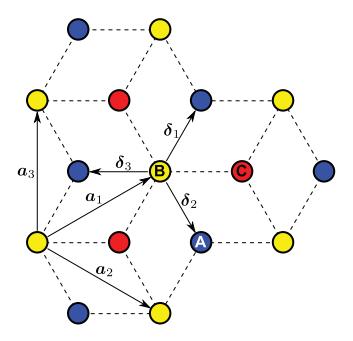
In our work we numerically analyse the topological properties of band structure of the T3 optical lattice (Fig. 1) using a tight-binding model. This lattice consists of hexagonal and triangular sublattices, connected with complex hopping elements. Such optical lattice for ultra-cold atoms can be made by using three overlapping laser beams, positioned in a plane at the angles $2\pi/3$. Maxima of the created electric field intensity make a triangular lattice, while minima make a hexagonal lattice. Because of dynamic second order Stark effect ultra-cold atoms feel an effective potential, proportional to the field intensity. Two-electron atoms, such as ytterbium or alkaline-earth atoms, feel the triangular or hexagonal lattice depending on their internal state (spin-singlet 1S0 or long-lived spin-triplet 3P0). One can couple such two internal states with an additional laser light and induce hopping between the two sub-lattices [2].
In the presentation we describe phase diagrams of various topological phases of T3 optical lattice and show its similarity to the simpler hexagonal lattice with complex hopping elements [3]. Since the T3 optical lattice can be described by three-level system, it gives more different topogical Chern insulator phases than the two-level hexagonal lattice.