NASICON materials have been extensively studied because of the high conductivity shown by some compositions and significant potential applications in electrochemical devices. [1,2]. The NASICON structure has a negatively charged 3D-framework, of general formula $M_2X_3O_{12}$, where the Na+ cations reside in fully or partially-occupied sites. The framework is built of $XO_4$ tetrahedra linked by corners to $MO_6$ octahedra. In general, the properties of the NASICON-type Na+ ion conductor compounds strongly depend upon the chemical stoichiometry, the crystal structure and unit cell parameters, that, at the same time, depend on the ionic radii of the cations located in octahedral (M) and tetrahedral (X) sites.[3] We have chosen the $Na_{1.3}X_{1.7}Al_{0.3}(PO_4)_3$ (X=Ti, Zr) and $Li_{0.65}Na_{0.65}Ti_{1.7}Al_{0.3}(PO_4)_3$ series because of the low cost of the elements, high conductivity and stability with aqueous solutions.
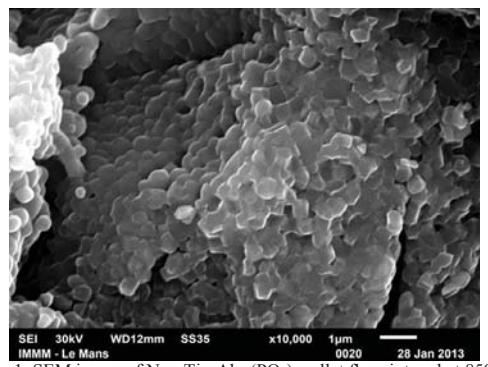
In the present work, the pure materials have been prepared by solid state reaction and by a Pechini-type method. The XRD patterns of the calcinated powders were recorded in order to refine the crystal structures. Thermodiffractometric data were recorded in order to follow the chemical reactions. The morphology of the samples was examined by Scanning Electron and Transmission Electron Microscopes (Fig. 1). The stability of NASICON powder in contact with water and humidity in ambient air was confirmed by using flame photometry and FTIR respectively. The sintering parameters were optimized on the basis of dilatometric data. The investigation of the electrical properties were performed in the frequency ranges $(10-3\cdot10^9)$ Hz by low frequency and microwave impedance spectrometers in order to determine the influence of grain size on electrical properties.