
Terahertz (THz) imaging and spectroscopy can be applied in various areas including material science, security systems, chemistry, medical industries, etc. The key-feature of THz radiation is ability to penetrate different kind of common materials like clothing, paper, plastic, packaging materials. As many chemical substances, drugs or explosive materials exhibit characteristic spectral THz signatures, it can be used for their identification [1].
In this work we extend such an approach to medicine drugs like vitamin C (ascorbic acid) and sedative drugs based on melatonin (Circadin and Stahl nacht) via Fourier spectra to determine spectral range needed for identification.
The samples were prepared from the vitamin C, Circadin, and Stahl nacht tablets. Each tablet was grinded into the powder with average particles size up to 300 μm. The samples were prepared from powder covered on the adhesive tape. Transmittance spectra of the samples were measured by the vacuum Fourier spectrometer. The transmittance was found by normalizing spectrum of the sample to the empty adhesive tape spectrum. The data were measured with 3 cm-1 spectral resolution in frequency range of 0.9-4.5 THz.
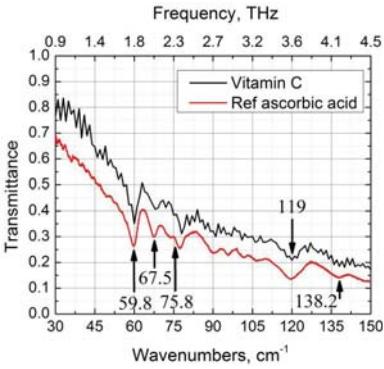
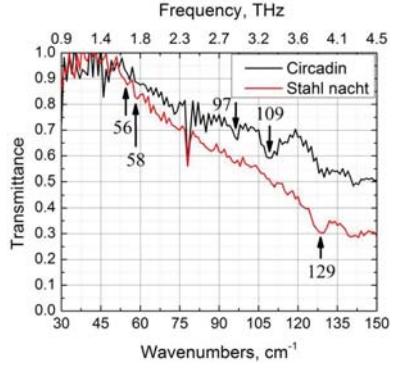
The transmittance of the vitamin C, Circadin, and Stahl nacht powders are shown in Fig. 1 and Fig. 2. Initialy, measured transmittance of the vitamin C powder was compared with reference spectra of ascorbic acid taken from materials database [2]. We note that the reference sample was prepared differently; the sample powders were compressed in the HDPE matrix. As it is seen from Fig. 1, measured absorption lines in our experiment correspond to the reference data. The transmittance spectra of two sedative drugs, in which major component is melatonin, are shown in Fig. 2. The minima at 56 cm-1, 58 cm-1, 97 cm-1, 109 cm-1 and 129 cm-1 are present in both samples spectrum and these lines can be attributed to the melatonin. Experiment data does not exclude those common excipients or other type additives those could be used in these drugs. We note large transmittance difference between two data which could be also an indicator of different chemical composition as well as material amount. Thus, quantitative material measurement and analysis is possible on medical drugs containing the melatonin. As it is seen, characteristic spectral signatures appears below 4 THz range.
The obtained results allow to infer that transmittance spectra of vitamin C, Circadin and Stahl nacht below 4 THz provides a possibility to distinguish different drugs containing melatonin.