
In this work surface relief holographic recording in Poly(Disperse Red 1 – methacrylate) thin films polymer was studied. Azo dye DR1 in this compound is chemically bonded to polymer chain what makes mass transport and surface relief formation more efficient and faster. This phenomenon can find further application in optoelectronics, data storage, and telecommunication devices [1-3].
Thin films of Poly(DR1-MA) were prepared using different solvent in order to obtain films with different thickness. For sample preparation different coating methods were used. That effected thickness and quality of the sample.
Holographic recording by solid-state diode-pumped laser with 532 nm wavelength was performed. Read-out by diode laser with 660 nm wavelength was made. Efficient surface relief grating formation was observed using
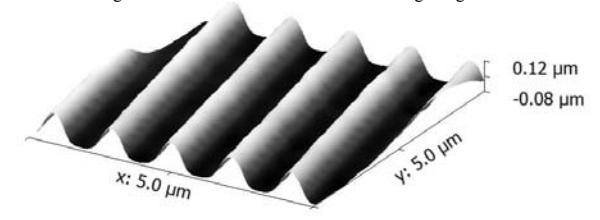
polarization state of recording beams which gives polarization modulation on the sample surface. Surface relief formation dependence on exposure, recording beam intensity, thickness of the sample and recording beam polarization state was studied. Grating formation was observed in wide range of recording beam intensities, but the depths of grating exceed the thickness of the sample and reached nearly double sample thickness.
Obtained results shows Poly(DR1-MA) copolymer is promising material for holographic recording and applicable in lithography for surface pattering.