
Shallow donors are known to be formed in epitaxial silicon implanted with hydrogen ions and subjected to subsequent annealing in the temperature range 200-500 °C. Introduction in silicon implanted with hydrogen ions and subjected to subsequent annealing both shallow and deep centres were observed by C-V and DLTS methods in the present research. C-V-measurements were carried out at frequency of 1 MHz and at low temperature (80-90 K), when emission rate of electron from deep traps was less enough then measuring frequency.
It was established, that irradiation of Schottky diodes (Pd -Si) results in increase of the depletion layer width (Fig.1.), in consequence of advantage introduction of large densities of E-centres (Ec-0.45 eV). A-center (Ec-0.17 eV) and VOH defect (Ec-0.32 eV) concentrations were insignificant (<1:1013 cm-3) in same time.
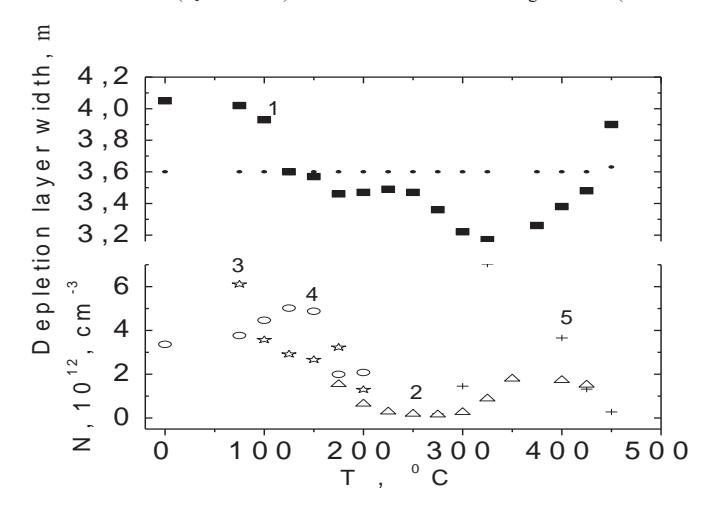
The depletion layer width becomes lower then pre-implantation value in the annealing temperatures above 200 °C. It indicates on the formation of shallow donors. Maximum donor concentration reaches at the T=350 °C. Their increasing at the range temperature of 250-350 °C correlates with introduction of the deep level defect (Ec-0.21 eV). Further increasing of the annealing temperature was accompanied by decreasing both electron and Ec-0,21 eV trap concentration. At the T=450 °C free carrier concentration decreases below then pre-implantation value, and simultaneously anomalous peak in the DLTS appears. This peak corresponds to trap with level of Ev+0,31 eV.
The nature of the deep traps with Ec-0,21 and Ev+0,31 eV levels and their role in the shallow hydrogen-related donor formation were discussed.