Light filament is a dynamic optical pulse structure with an intense central core, which is able to propagate distances much larger than typical diffraction length and keep the narrow pulse width without external channeling mechanism [1]. When the input power is far above the critical power self-focusing ($P_{cr}$) in nonlinear medium, the beam breaks up into a large number of filaments [2]. Light filaments display interesting and unique features such as white light spectrum, conical emission, sub-diffractive propagation, pulse shortening and splitting, etc. It is important to visualize light filaments in space and time domains to get better understanding of nonlinear phenomena governing light-matter interaction.
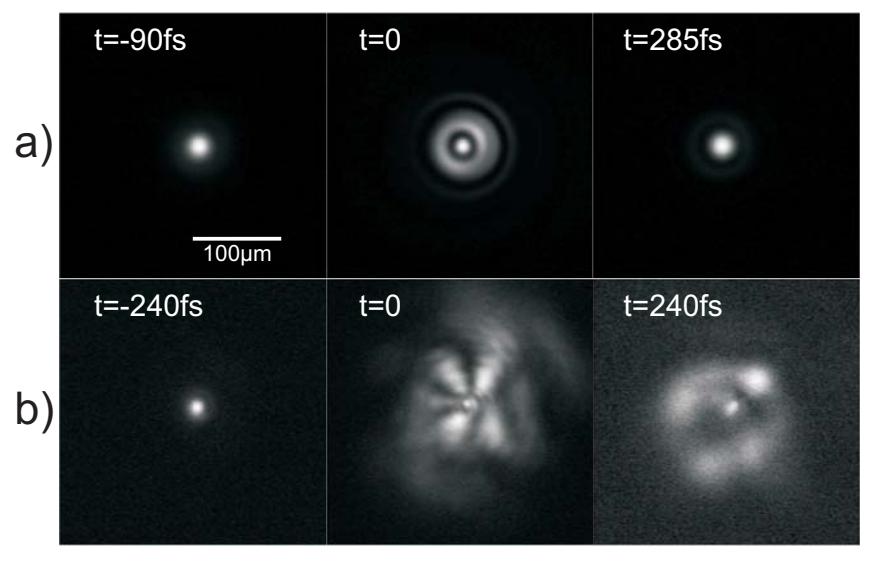
In this work spatial and temporal dynamics of single and multiple filaments formed in water by propagation of an intense 100 fs pulse with wavelength of 400 nm are studied. Three dimensional mapping method with high spatial (1 μm) and temporal (30 fs) resolution [3], based on cross-correlation via difference-frequency generation was used for visualising spatiotemporal intensity profiles of the filaments. The typical profiles, which were recorded at the input power of 5 and 11 Pcr are shown in Fig. 1 (a) and (b), respectively. At the input power of 5 Pcr, the filament shows pulse spliting and occurrence of concentric ring structure at (t = 0), which breaks up into multiple filaments at 11 Pcr. Dynamics of filaments were vizualised in two and three dimensions including the isointensity surface of multiple filaments, in which transformation from a single filament to multiple filaments is captured in detail.