EPIGALLOCATECHIN-3-GALLATE AS A POTENTIAL INHIBITOR OF INSULIN AMYLOID-LIKE FIBRIL FORMATION
Akvilė Botyriūtė1, Vytautas Smirnovas1
1 Department of Biothermodynamics and Drug Design, Vilnius University Institute of Biotechnology, Vilnius, Lithuania
Amyloid fibril formation is a common event in human protein misfolding disorders, including Alzheimer's, Parkinson's, type-II diabetes and other diseases. In order to treat these disorders scientists are searching for efficient inhibitors which can prevent fibril formation. A number of studies show that (-)-epigallocatechin-3-gallate (EGCG) frequent compound in a green tea can repress amyloid fibril formation of proteins such amyloid-beta, alpha-synuclein and others [1-5].
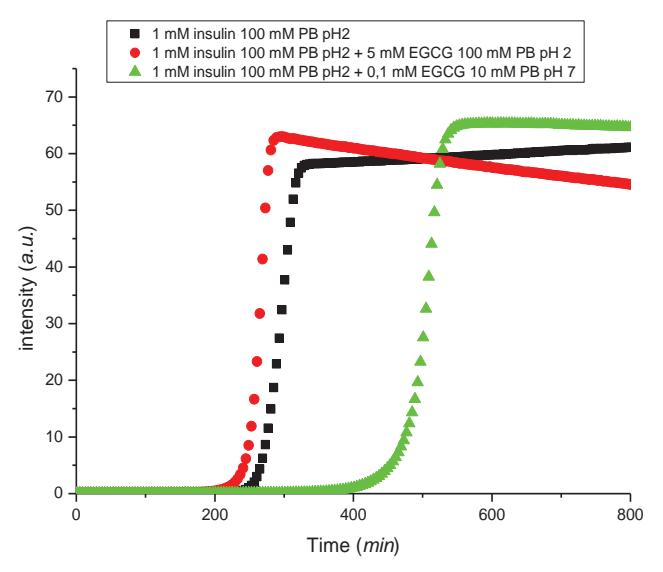
We checked EGCG influence on recombinant human insulin fibril formation. Contrary to previous studies [1-5] our initial experiments revealed no significant effect using EGCG concentrations up to 5 times higher than insulin. We found out one major difference in experimental conditions. Most of previous inhibition studies were carried out in (or near to) neutral pH [1-4] and ours in pH 2. Having in mind reports of low stability of EGCG in neutral pH [6] we incubated it for 24 hours in neutral pH before using it to insulin fibrillation experiments. In this case inhibition was observed even when EGCG concentration was 10 times smaller than insulin. Therefore we can assert that actual inhibitor of amyloid-like fibril formation is not EGCG but its derivative which occurs over incubation at neutral or higher pH.
Fig. 1. Insulin amyloid-like fibril formation over time (experimental data of Thioflavin T fluorescence assay).
[1] D. Ehrnhoefer, J. Bieschke, et al., EGCG redirects amyloidogenic polypeptides into unstructured, off-pathway oligomers, Nature structural & molecular biology15, 558-566, (2008).
[2] J. Bieschke, J. Russ et al., EGCG remodels mature α-synuclein and amyloid-β fibrils and reduces cellular toxicity, Proc Natl Acad Sci U S A107, 7710-7715, (2010).
[3] A. S. Rambold, M. Miesbauer et al., Green tea extracts interfere with the stress-protective activity of PrPc and the formation of PrPsc, Journal of neurochemistry107, 218-229, (2008).
[4] B. E. Roberts, M. L. Duennwald, et al., A synergistic small-molecule combination directly eradicates diverse prion strain structures, Nature chemical biology5, 936-946, (2009).
[5] M. Levy-Sakin, M. Shreberk et al., Targeting insulin amyloid assembly by small aromatic molecules Toward rational design of aggregation inhibitors, Islets1, 210-215, (2009).
[6] S. Sang, M. LEE et al., Stability of Tea Polyphenol (-)-Epigallocatechin-3-gallate and Formation of Dimers and Epimers under Common Experimental Conditions, Journal of agricultural and food chemistry53, 9478-9484, (2005).