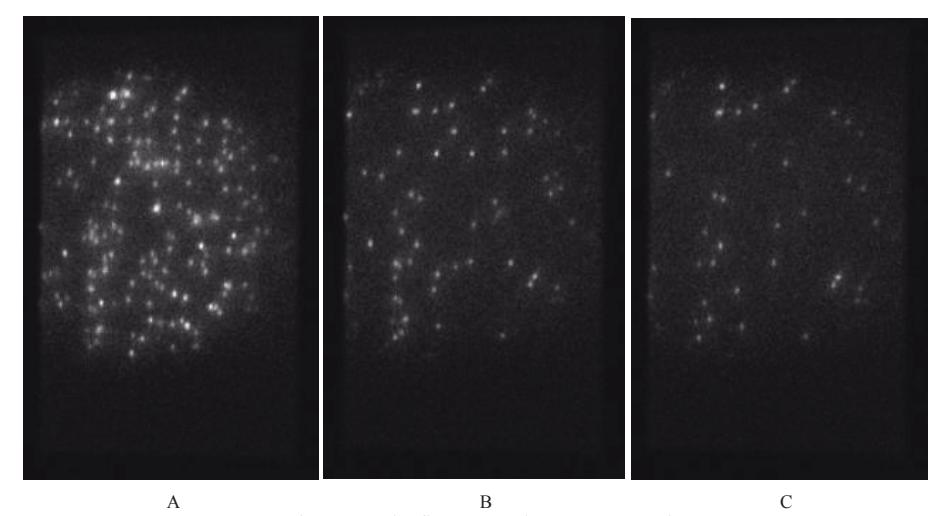
Two decades ago two scientists from USA managed to show that they detected absorption of fluorescence from single molecule [1]. Since then many scientists worldwide are using different techniques to detect and gather different information from single molecules.
In center for physical sciences and technology single molecule spectroscope was build and has two options to detect single molecules: using wide field and confocal fluorescence microscopies. Short DNA structures were labeled with two different cyanine dyes: Cy3 and Cy5, third group was labeled with both dyes. Cy3 dyes fluorescence at 560 nm wavelength and Cy5 at approximately 660 nm wavelength [2]. For excitation was used 532 nm wavelength solid state laser.
Detection fluorescent light was possible in two ways: using EM-CCD or Avalanche photo diode. Both detectors count photons which hit detector matrix.
Single molecule experiment requires high quality cleanliness - this makes preparation for experiment difficult. Also cyanine dyes react with oxygen. Those two factors lead us to create a sample cell. Two versions of cells were made, but the construction of them were similar. Two microscope slides were separated with Teflon spacer to create a cell between two glass windows. One glass window has two drilled holes where Teflon pipes are connected for flowing liquids. This kind of cell is gently pressed with two plastic frames to seal it.
DNA chains has negative charge, so does the microscope slide after cleaning in plasma cleaner [3]. For this reason slides were functionalized with mono layer in two ways. One with protein poly-l-lysine, other with antigen Anti-digoxigenin. Mechanics of both molecular functionalization are different, but effect is similar, DNA connects to mono layer of protein or antigen. Empty space in cell is filled with buffer which does not have fluorescence signal.
All experiment is automatized with "Lab View" software. Three axial cell table, shutters, detectors, cameras and other electronics are controlled by computer.
Data: it is possible to register spectra, time how long particles were able to fluorescent (dynamics) and compare photon counts of different particles.