
The generation of harmonics depends on the nonlinear susceptibilities of media and those susceptibilities can be measured using harmonic generation. The aim of this work was to generate higher odd harmonics in solid media without inducing optical damage in the process.
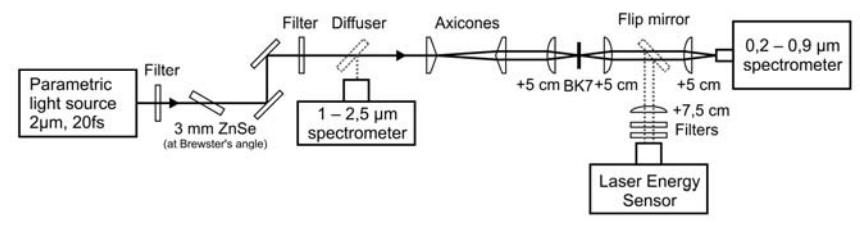
We used a parametric light source, which delivered 20 fs, 50 $\mu$J pulses at 2 $\mu$m. ZnSe crystal was used to compensate dispersion in lens and axicones and generate harmonics from shorter, higher intensity pulse. Diffuser was a temporary part of setup, used to divert original pulse to MIR spectrometer. Axicones generated ring-shaped laser beam, which was then sharply focused into the sample. Sharp focusing allowed generating harmonics while avoiding the generation of supercontinuum. 4f system (two +5 cm lens) was used to collect the generated harmonics into the optical fiber connect to spectrometer. Flip mirror could be used to measure the energies of individual harmonics with filters and energy sensor. We used 0.15 mm BK7 glass sample, as it gave the best results compared to other available samples.
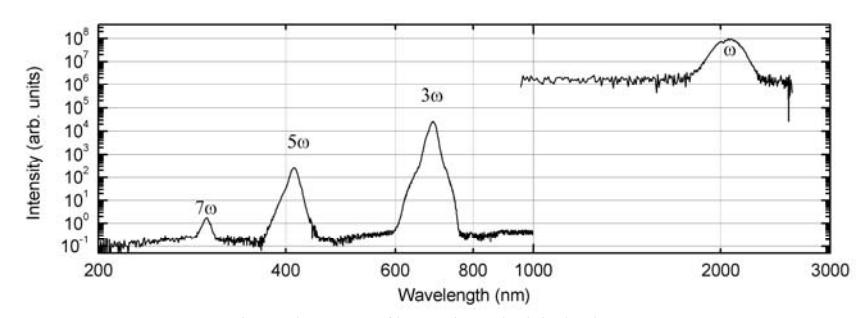
During the experiment, 3rd, 5th and 7th harmonics were generated in BK7 glass sample. We have measured the relative energies of harmonics ($E_{\omega} / E_{3\omega} \approx 1000$; $E_{3\omega} / E_{5\omega} \approx 150$; $E_{5\omega} / E_{7\omega} \approx 190$) and their bandwidths ($\Delta f_{\omega}=13$ THz; $f_{3\omega}=11$ THz; $\Delta f_{3\omega}=19.5$ THz; $\Delta f_{3\omega}=29$ THz). Our ability to measure 9th and higher harmonics was limited by the aberrations in 4f lens system, optical damage when using higher energy pulses and the limited sensitivity of spectrometer. More experiments are planned with alternative setups and samples.