
Organic solar cells are a promising technology for future power generation. Recently the efficiency of bulk heterojunction organic solar cells has been doubled from 4–5% up to 10% by using new materials while keeping the same device structure. However, it is not entirely clear which material properties cause better device performances.
Exciton diffusion is one of the key-processes in the operation of organic solar cells. Excitons or bound electron-hole pairs created in organic semiconductors after absorption of light have to be separated into free charges in order to generate photocurrent. Such a separation is normally achieved at the interface of an electron accepting and electron donating materials. Excitons reach this interface by incoherent hopping, therefore the diffusion length determines the amount of excitons that can contribute to the photocurrent, and consequently, to the device efficiency. To this end, systematic measurements of exciton diffusion length are required to develop the synthetic guidelines for the enhancement of the solar cell efficiency.
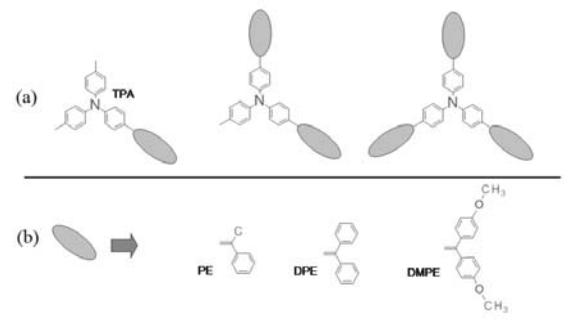
In this work, exciton diffusion in a series of triphenylamine derivatives, known to possess excellent hole drift mobilities and having different number of 2,2-methylphenylethenyl, 2,2-diphenylethenyl and 2,2-di(4-methoxyphenyl)ethenyl side-moieties, were investigated (Fig. 1). Exciton diffusion was evaluated by measuring fluorescence quenching in the triphenylamine amorphous films with randomly distributed quenchers. In order to determine the exciton diffusion length, Monte Carlo simulation modeling of PL decays in organic semiconductor–quencher blends was performed [1]. The obtained data revealed that the increasing number of side-moieties results in higher exciton diffusion coefficient (up to $5.4 \cdot 10^{-4}$ cm2/s) and in increased exciton diffusion length varying from 3.1 nm to 11.1 nm. Intuitively, the incorporation of more side-moieties into the triphenylamine core makes molecular structure more branchy and should prevent dense molecular packing in the solid state resulting in reduced exciton diffusion length. However, in this particular case, phenylethenyl side-moieties most likely arrange themselves in a densely overlapping pattern, which facilitates exciton diffusion and results in the larger diffusion length.
Due to the large exciton diffusion length and outstanding hole drift mobility (up to $1.7 \cdot 10^{2}$ cm2/Vs) [2] triphenylamine derivatives are attractive for application in high performance bulk heterojunction organic solar cells.