
Electromagnetic radiation responding to frequencies of around 1012 Hz (Terahertz, THz) has been quite underdeveloped due to the technological dificulties of creating reliable and compact sources and detectors of radiation. Hence, an important step in order to implement THz imaging systems is to develop sensors that would work effectively at room temperature. Curently, there are three dominating approaches in this activity: field-effect tranzistors with two-dimensional electron channels, microbolometers and bow-tie diodes.
InGaAs bow-tie diodes – they are called so due to the constructional features of the sensor (Fig. 1) – were found to be rather simple solution for THz detection [1]. The operation principle relies on creation of non-uniform electromagnetic field that arises in the semiconducting leaf of the diode when the incident radiation is concentrated to the latter by the metalized leaf part of the device. As a consequence, inhomogeneous field heats electrons that diffuse away from the necked part and thus generates de voltage over the terminals.
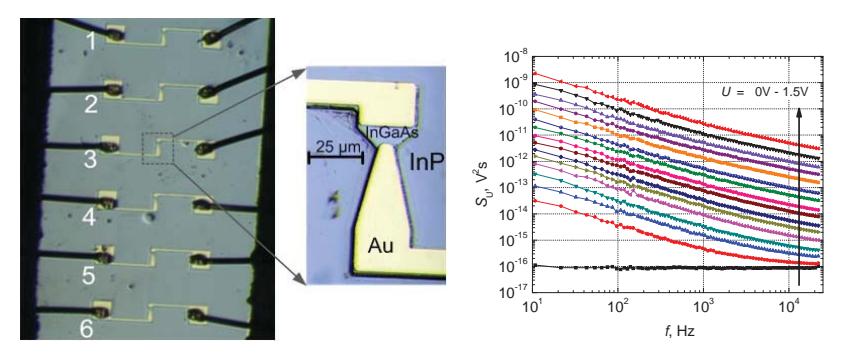
By investigating characteristics of low-frequency (10 Hz to 20 kHz) noise it is possible to reveal physical processes behind the operation of sensors, to determine sources of noise and reveal therefore routes to improve noise characteristics of the device [2].
Investigation was carried out for a array composed of the line with 6 detectors (Fig. 1) in lattice temperature ranging from 77 K to 360 K. As it is seen from Fig. 2, at room temperature spectral density of voltage fluctuations varies approximately as 1/f indicating that the origin of noise is superposition of generation and recombination processes in the defects of the structure. With the decrease in temperature, Lorentzian type spectra prevails over 1/f type spectra and within 150 – 200 K all investigated samples exhibit characteristic time ranging from few to hundreds of microseconds. The estimated activation energies were found to be from 0.2 eV to 0.4 eV. These results allow to infer that structural defects are responsible for intensive generation and recombination process.