Terahertz (THz) radiation is frequency range between microwave and far infrared of the electromagnetic radiation spectrum. THz radiation can propagate through many dielectric materials, such as clothing and common packaging substances so it is possible to use it for non-destructive and non-ionizing way of imaging and spectroscopy [1]. It could be successfully used in security applications, particularly for explosive, chemical and biological agents detection. In order to inspect agents high sensitivity detectors such as bow-tie detectors must be developed. Bow-tie diode is suitable for sensing of electromagnetic radiation over a broad, 10 GHz–2.52 THz, frequency range at room temperature [2]. The bow-tie diode consists of trapezoidal shape n-doped semiconductor, with metal contacts connected to short and long edges. The device operation is based on non-uniform electron heating due to its asymmetric geometry.
Although bow-tie diode performance was demonstrated experimentally, some of its operation mechanisms still lack a theoretical explanation. So in this work we analysed bow-tie diode electrical characteristics. The device current-voltage characteristics, the spatial distributions of electrical field, carrier density and electron temperature were simulated using TCAD Synopsys semiconductor device modelling software. To account for hot electron effects hydrodynamic transport model [3] was used. Current density in this model was calculated using this equation:
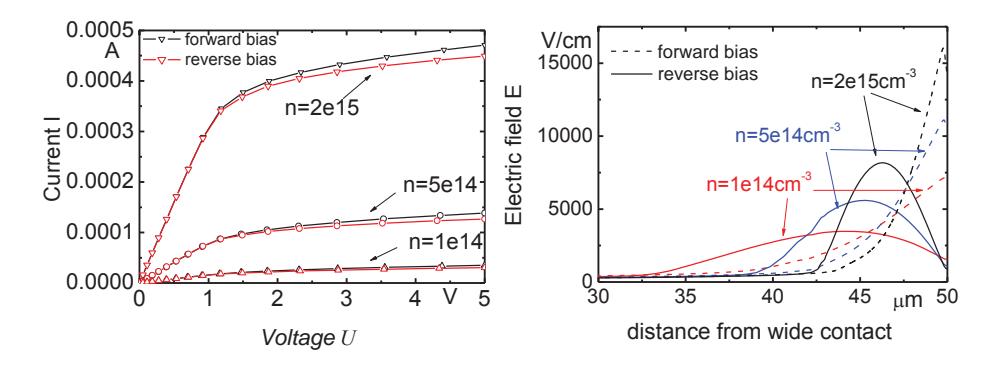
$$J_n = k\mu_n \nabla (n \cdot T_n) + en\mu_n E$$Simulation results showed asymmetry of I-V characteristic, i.e. that reverse current is smaller than forward current (Fig. 1). This due to the fact that, electric field distributes in a wider area of the device when reverse bias is applied (Fig. 2), so electron mobility is decreased in a wider area too. This means that electric resistance is larger when reverse bias is applied.