
Optical coatings are widely used to reflect, split or modify laser beams in optical systems. Some coatings are relatively straightforward to make, while others, e.g. large diameter lenses, curved substrates, linear variable filters, Gaussian mirrors must satisfy higher requirements. One of these requirements is thickness uniformity or nonuniformity [1]. Moreover thickness uniformity is essential for production of identical optical coatings stacks. The purpose of this research was to investigate, improve and change thickness uniformity of ion beam sputtering (IBS) deposition technique.
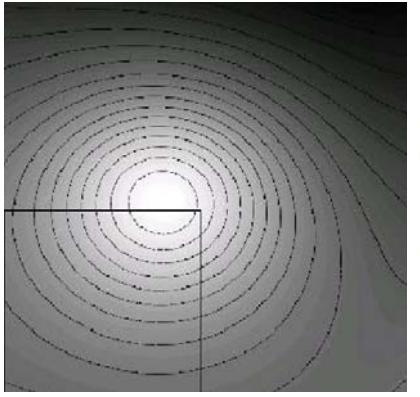
IBS deposition system consists of ion gun, sputtering material target and substrate palette. Layer thickness uniformity is strongly increased by rotating substrate holder. However, this is usually not enough. Without rotation film thickness distribution mostly meets Gaussian distribution. In this research it was noticed and experimentally checked that thickness distribution can be approximately evaluated by function S(x,y), Eq. (1), where R(x,y) is correction function. S(x,y) function is shown in Fig. 1 and substrate palette is depicted by a black square.
$$S(x,y) = A_1\exp\left(-\left(\frac{x - x_0}{g_x}\right)^2 - \left(\frac{y - y_0}{g_y}\right)^2\right) + R(x,y)\tag{1}$$Function S(x,y) provides all the information about sputtering intensity in all substrate palette area. It was used to investigate and change thickness uniformity in sputtering process with rotational motion. Coating thickness was modulated by using shadowing mask technique - precise form metal plates [2]. Precise mask, cut using laser machining system, covers slice of sputtered particle's flow to substrate palette. It was experimentally demonstrated that this method can be used to obtain various film thickness profiles.
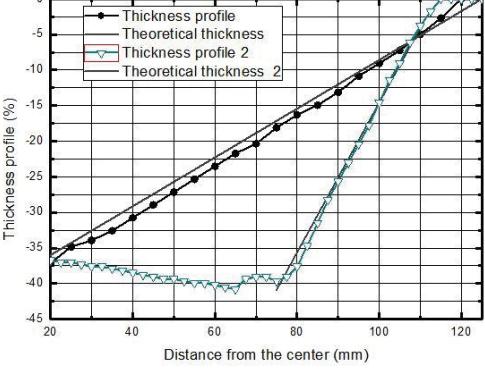
In this research several shadowing masks were prepared and tested. Each of them had to influence different film thickness profiles. Two profiles (theoretical profile and experimental data) are shown graphically in Fig. 2. Distance was measured from the center of substrate palette.
Shadowing mask technique is universal and easily applicable. If research is done accurately, almost any thickness profile may be obtained.