
Graphene is a single layer of carbon atoms bound through sp2 bonds forming a hexagonal two-dimensional crystal lattice. It has a very high electron mobility at room temperature, with values of up to 200,000 cm2 V-1 s-1. This form of carbon is the strongest material ever known, theoretically perfect graphene sheet is about 100 times stronger than steel. Graphene has high optical transparency of 97.7 %, high thermal conductivity of up to 5000 Wm-1K-1, extremely high theoretical specific surface area of 2630 m2/g and is not permeable to gas. Graphene due to its outstanding thermal, mechanical and electrical properties is employed in nanoelectronics, biotechnology, sensoring, nanofiltration, etc. [1]. One of the most promising applications of graphene-based materials is their use as transparent, conductive thin films. For this purpose they must be transferred onto arbitrary insulating substrates. Initially, graphene coatings can be produced by micro-mechanical exfoliation of graphite, epitaxial growth, chemical vapor deposition on metal substrates such as Ni and Cu. Precursors most commonly used to produce graphene coatings are graphene oxide (GO) films [2].
GO has a layered structure similar to that of graphite, however, the basal plane of carbon atoms in graphene oxide is densely decorated with hydroxyl, epoxy, carbonyl and carboxyl groups. Presence of functional groups not only expands the interlayer distance but also improves the hydrophilic properties and dispersibility of GO. GO dispersions are used to produce GO films by spin-coating, dip-coating, spraying, vacuum filtration, Langmuir-Blodgett methods [3-4].
In the laboratory GO was synthesized by a Hummer's method [5] from graphite using NaNO3, H2SO4 and KMnO4. Obtained brown powder was dried and used for the fabrication of GO coatings onto polycarbonate substrate [6]. Simultaneously, nanocomposite coatings composed of GO and Congo red (CR) and exfoliated GO have been fabricated
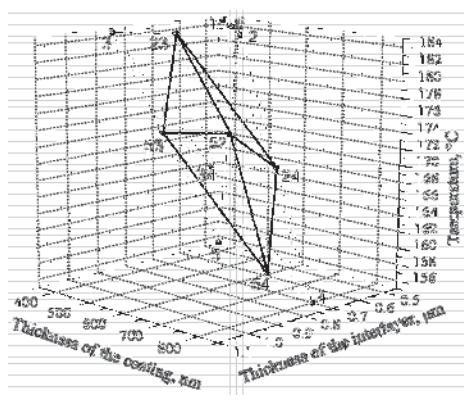
using the same protocol. Obtained coatings were dried at room temperature, cut-off from cylinder and transfered onto the transparent polyethylene terephthalate (PET) substrate by heating and pressing. Simplex-optimization for three most significant factors (temperature, thickness of the interlayer and thickness of the coating) was performed. Experiments were carried out using combinatorial approach. Libraries were prepared on the basis of previuos tests for optimization using a Plackett-Burman experimental design and examined by different methods (optical microscopy, SEM, contact angle measuring, electrical conductivity and adhesion testing). Optimal conditions for transfer of GO coating were found as follows: temperature -185 °C, thickness of GO coating - 500 nm and thickness of the interlayer – 0,80 μm.