Interest in organic semiconducting materials has been recently increasing because of their potential applications in electronics. Organic photoactive materials are extremely attractive due to great mechanical properties and low cost of production. However, we are facing a problem combining stability and processability with charge transport properties. Widely investigated effective charge transporting materials are indolo[3,2-b]carbazoles.
New class of compounds based on indolo[3,2-b]carbazole are being studied as hole-transporting materials. These compounds can be well utilized as hole-transporting layers in organic light emitting diodes (OLEDs) because of their high thermal stability and determinable hole-injecting and transporting properties [1-3].
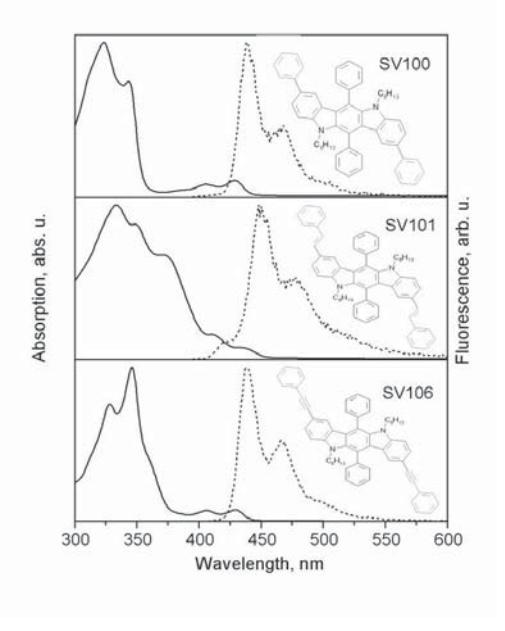
In our work we present analysis of properties of three new indolo[3,2-b]carbazole compounds named as SV100, SV101 and SV106, under names of different connection of benzene functional group. Compounds were investigated as solutions using chloroform solvent and as thin films. Films were made by spin coating technique using polystyrene as matrix material. Sample thickness was about few hundred nanometres.
In solutions fluorescence kinetics decay monoexponential, meanwhile in thin films it consists of two exponential decays. Also a large influence of oxygen and evaporated aluminium electrodes to fluorescence quenching was observed. Optical properties of investigated materials showed no dependence of added electrical field.