
The interest to rotational and vibrational-rotational spectra of hydrogen bonded compexes drastically increased in recent years. Few works appears on rotational spectra of methanol dimer [1,2] which note a decrease of barriers to methyl tops internal rotation upon complex formation. Interest in H- bonding of the metanol dimer is due to the fact that it is among the simplest organic molecules, which could exhibits hydrogen bonding, and like (H2O)2 it also exhibits multidimensi-onal tunneling splittings of torsion-rotational states. However, no articles in literature was found in which the theoretical study of spectral and structural characteristics of the methanol dimer in the gas phase has been performed. The optimized geometry of methnol dimer (Fig.1) was found using quantum mechanical package GAUSSIAN 09.
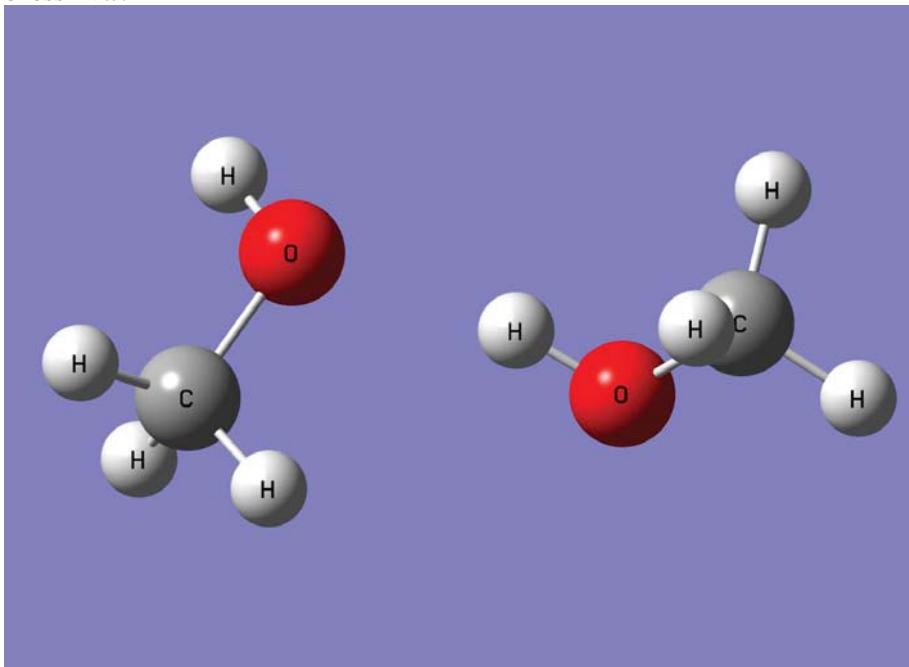
Then IR spectrum of dimer was calculated in harmonic and anharmonic approximation. It was found that frequencies of donor and aceptor hydroxil stretchig vibrations in dimer are 3500.4 and 3654.9 cm-1. The rotational constants in ground vibrational state were calculated too: $A_{00}$=16805.593 MHz; $B_{00}$=2212.790 MHz; $C_{00}$=2183.509 MHz. It is in reasonable agreement with experimental data [2]: $A_{00}$=14310.171 MHz; $B_{00}$=2281.006 MHz. The vibration-rotation interection constants were calculated for metanol dimer. It was found that for $V_{OH}$ vibration this constants are negative but not too high as it was expected [3]. The barriers to methyl tops internal rotation were calculated and its values in good agreement with experiment data [1,2].