
The band gap of ternary nitride compound, indium gallium nitride, can be adjusted by changing the ratio of indium atoms to gallium atoms. This makes InGaN materials attractive for use in optoelectronics and photovoltaics. InGaN is already widely used in commercially available blue and white light-emitting diodes (LEDs). However, attempts to manufacture LEDs emitting light at longer wavelengths encounter problems due to increased defect density, strong influence of internal electric field, and carrier localization. Thus, carrier dynamics in InGaN epilayers and heterostructures is still under intense study. One of the approaches to reduce the problems caused by increased internal field and defect density is using quantum wells (QWs) with unconventional, nonrectangular shapes.
In this work, the luminescence properties of QWs with three different shapes (rectangular, triangular, and trapezoidal) were compared. The differently shaped multiple quantum well (MQW) structures were grown using metalorganic chemical vapor deposition (MOCVD) on sapphire substrates at the Institue of Applied Research, Vilnius University. QWs with different shapes were grown by changing the growth temperature inside the MOCVD reactor while other growth parameters were maintained constant. The growth temprature and precursor gas flow rate were adjusted to keep the In content at 15-16% in the well bottom and at 8-10% at the top of the potential barrier in all samples. Moreover, the average In content varied along the wafer diameter due to temperature gradient.
The samples have been studied using confocal and atomic force microscopy. WITec alpha300 microscope system coupled with a spectrometer was used. The photoluminescence spatial distribution was measured in confocal mode with 250 nm spatial resolution. Laser diode ALPHALAS emitting at 405 nm was exploited for excitation. Photoluminescence measurements were compared to the results on surface morphology obtained using the WITec alpha300 system in atomic force microscopy mode.
The study evidenced more homogenous spatial distribution of photoluminescence in samples with triangular and trapezoidal QWs, as compared to rectangular QWs. The spatial distribution of luminescence intensity in different samples is compared in Fig. 1.
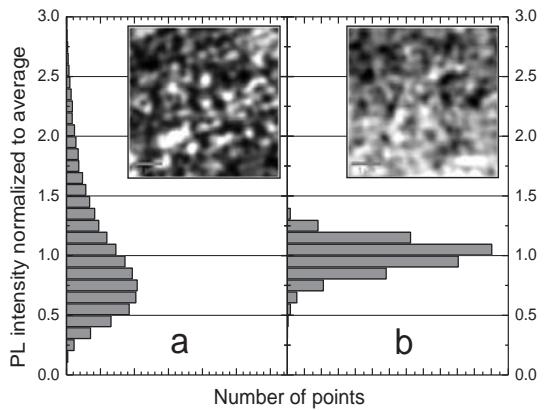
As the indium content was increased, the samples with rectangular QWs exhibited an decrease in photoluminescence intensity and even higher inhomogeneity. Meanwhile, the samples with triangular and trapezoidal QWs showed an increase in photoluminescence intensity and better homogeneity. The correlation between local luminescence intensity and peak energy of the emission band have been calculated but did not show distinct features for different samples.
The investigation of luminescence spatial distribution and surface morphology show that InGaN structures with triangular or trapezoidal quantum wells are promising for development of green-yellow light emitters.