
High harmonic generation (HHG) is a process in which bursts of coherent ultraviolet and/or soft x-ray radiation are generated by firing intense laser pulses into dilute gases. These bursts can last below 100 attoseconds (1as = 10-18s), making HHG radiation bursts the shortest currently known electromagnetic pulses. One improved scheme of HHG is two-color high harmonic generation, when the driving laser pulse is used in conjunction with its second harmonic. This has several desirable effects, such as raising the total generation efficiency and producing even-numbered harmonics, otherwise absent in HHG spectra [1].
Two-color high harmonic generation requires precise control over the polarizations of the driving pulses and the time delay between them [2]. While this is readily achieved by splitting the fundamental and second harmonic beams and performing the necessary operations on the beams separately, such setups are tedious to align. We designed, constructed and tested a collinear optical system that could replace a two-color interferometer.
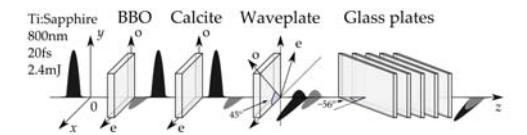
A schematic drawing of the setup is shown in fig. 1. The setup is optimized for use with Ti:Sapphire lasers operating in the 750-850nm wavelength range. First, the second harmonic is generated in a BBO ($\beta$-Barium Borate) crystal. The 800nm pulse is delayed with respect to the 400nm pulse by a plate made from calcite. It is followed by a crystalline quartz plate that works as a zero-order 2/2 waveplate at 800nm and a 1.2 waveplate at 420nm. The polarization of the 800nm pulse is rotated by 90°, while the polarization of 400nm light is unchanged. Finally, because of the limited bandwidth of the waveplates, a series of glass wafers as thin as 100μm are used to clean the polarization of the pulses by reflecting the electric field components polarized in the unwanted direction as HHG efficiency is severely reduced if the driving pulses have elliptical polarization.
An example of a high harmonic spectrum generated using this setup is shown in fig. 2. A one-color HHG spectrum produced in the same system from only the 800nm pulse is also shown for comparison.
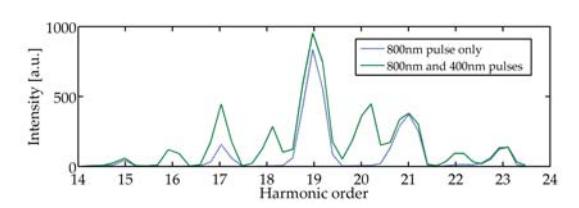
The collinear system is a suitable replacement of a two-color interferometer. Even though about 10% of the second harmonic pulse energy is lost due to the finite bandwidth of the waveplate, the setup is efficient enough to reliably generate high harmonics in the two-color regime. Furthermore, the setup is very easy to operate. Most importantly, the switching time between one- and two-color HHG experiments has been reduced to a few minutes, which will allow researchers to try more experiments in both one- and two-color modes.