
The electromagnetic pulse (EMP) generated in free space by natural or artificial electromagnetic pulse sources, such as lighting, nuclear EMP or Directed Energy Weapons, can induce high power over-currents in electronic equipment and damage its active electrical components [1]. In order to protect electronic circuits to withstand short EMP, fast fault current limiters are required. Switches based on gas discharge plasma limiters, varistors, and other protectors are slow due to large intrinsic capacitance and their response time is limited to microseconds [2]. Taking into account that EMP pulses are bipolar, the design of symmetrical protectors is of great importance. It was demonstrated [3,4] that thin films of perovskite manganites can be used for fast fault current limiter applications.
In this work, the effects of strong electric fields on the resistivity of thin nanostructured La-Ca(Sr)-Mn-O films, deposited on lucalox substrates by a MOCVD technique with thicknesses of 350 nm were investigated at 5-290 K temperature range in a closed cycle helium gas cryo-cooler by using electrical pulses with pulse lengths of 5 ns, and amplitudes up to 500 V.
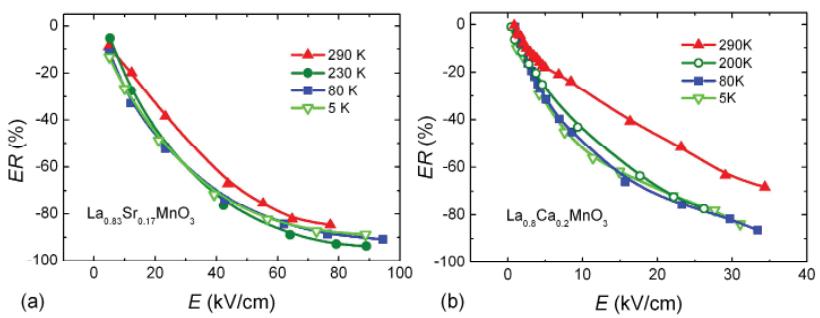
It was obtained that nanostructured La-Ca(Sr)-Mn-O films exhibit negative electroresistance (ER) phenomenon at applied strong electric field. The ER was defined by the formula: ER=100%$\cdot$[R(E)-R(0)]/R(0), where R(E) and R(0) are resistances of the film at high and low electric field, respectively. The influence of film chemical composition was analyzed in order to determine the optimal conditions for the design of protectors operating at low temperatures (liquid nitrogen) as well as room temperature. The electroresistance measured at electric fields with amplitudes up to 90 kV/cm for the La-Sr-Mn-O films and 35 kV/cm for the La-Ca-Mn-O films is presented in Fig. 1. One can see that absolute values of ER increase with the electric field strength. The highest ER values were obtained at temperatures, equal or lower than metal-insulator transition temperature $T_{\rm m}$ of the films: 200 K for the La-Ca-Mn-O films and 230 K for the La-Sr-Mn-O films. Such electroresistance effect is related to the existence of grain boundaries in the nanostructured films and in most cases this can be explained by inelastic charge carrier tunneling [5]. The most evident difference between the La-Ca-Mn-O and La-Sr-Mn-O films is the strength of the electric field at which the same ER is achieved. For the La-Ca-Mn-O films, this field is 1.7–2 times lower. The threshold field at which the resistance decreases was also lower for films doped with Ca: 0.8 kV/cm at 80 K, 1.1 kV/cm at 290 K, while for the La-Sr-Mn-O film, this was 2.5 kV/cm and 9 kV/cm, respectively.
The losses L(E) in the transmission line induced by the manganite films were investigated when connecting the samples in parallel to a transmission line. It was demonstrated that using manganite films doped with Ca it is possible to obtain better limiting characteristics at lower threshold electric field values: for La-Ca-Mn-O films the $L\approx 4$ dB when E=25 kV/cm, while for La-Sr-Mn-O films the same losses were obtained at 90 kV/cm.