
Recently, optoelectronic devices operating in UV region attracts much attention for their potential applications in flame sensing, chemical/biological agents detection, missile plume sensing, air and water purification, etc.[1] For this purpose, visible light blind photodetectors are being developed. In order to increase their efficiency, temperature stability is looking for new material for their production. MgZnO alloys may be used in the manufacture of such phtodetectors.
Compared with others materials ZnO based semiconductors can be grown at lower temperature. However, because ZnO and MgO different crystal structure phase separation occurs. ZnO buffer layer is used to make suitable crystal structure for the growing of MgZnO layer. In this way it is possible to grow single – phase hexagonal structure MgZnO with a bandgap energy 4,65eV.[2] To use this material in optical devices, it is necessary to known precisely the energy band structure and optical properties. In this work, series of MgxZn1-xO epitaxial layers with different Mg quantity (x = 0.025; 0.166; 0.303; 0.318) grown by MBE has been investigated.
This work aim was to find MgZnO band gap energy using diffuse reflectance spectroscopy. Results of diffuse reflectance are shown in (fig. 1) could be seen sharp absorbtion edge at 3.33 eV energy and smaller ones in deeper UV region.
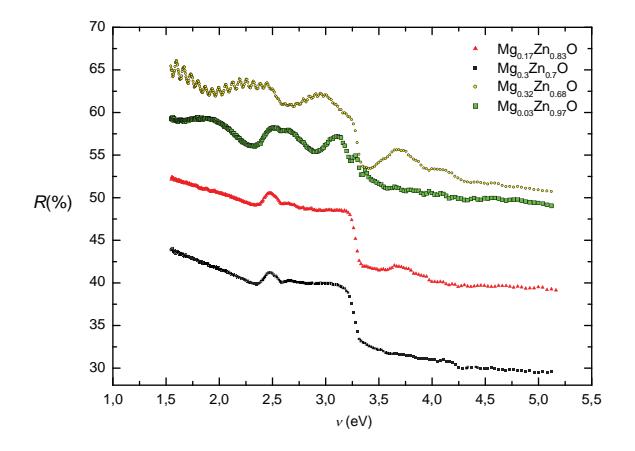
It was found that increasing the amount of magnesium band gap energy increases from 3.41 eV to 4.25eV. A phase segragation occurs at ~30% Mg. Increasing Mg content also increases the Stoke shift.