
Application of terahertz (THz) waves for security, medical diagnostic and imaging needs to develop compact and powerful THz emitters which could operate at room temperature. This work is dedicated to estimate a potential of technology of GaN based structures in developing high electron mobility transistors (HEMT) as possible THz emitters [1].
Magnetotransport measurements in strong magnetic field (up to 10 T) at low temperature (2 K) were performed to determine electron concentration and mobility in MOCVD (Institute of Applied Research, Vilnius University) grown AlGaN/GaN heterostructures. From magnetoresistance curve analysis at weak magnetic field [2] electron mobility was found to be $\mu = 2500 \text{ cm}^2 \text{ V}^{-1} \text{ s}^{-1}$.
It was determined that Shubnikov-de Haas (SdH) oscillations start to appear at B = 3.5 T. Analyzed data of experiment is shown in Fig. 1. It is seen that SdH oscillations' amplitude reflecting electron mobility dependence is sensitive to the direction of the applied magnetic field [3]. The main reason for this inequality is that the sample was placed not in the exact center of the magnetic field.
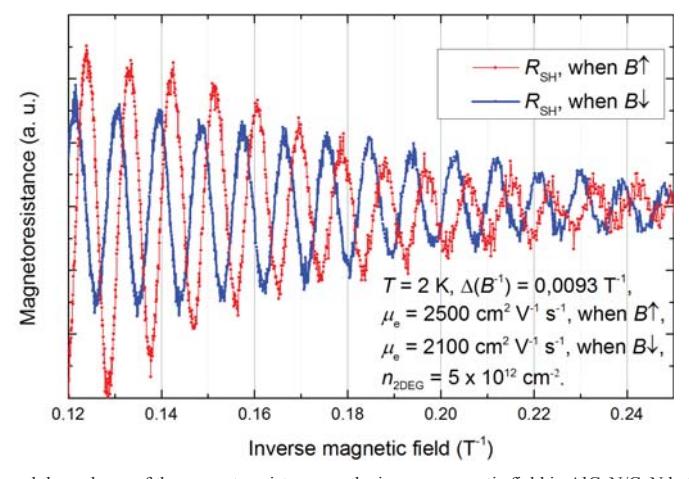
From the dependence of magnetoresistance on inverse magnetic field two dimensional electron gas (2DEG) concentration n was estimated using equation
$$\Delta\left(\frac{1}{B}\right) = \frac{e}{h} \frac{g_{\rm S} g_{\rm L}}{n},\tag{1}$$where B is the magnetic field strength, e is the electron charge, h is the Planck's constant, $g_{\rm S}$ and $g_{\rm L}$ are electron spin and orbital g-factors respectively. The concentration of 2DEG is found to be 5 x 1012 cm-3.