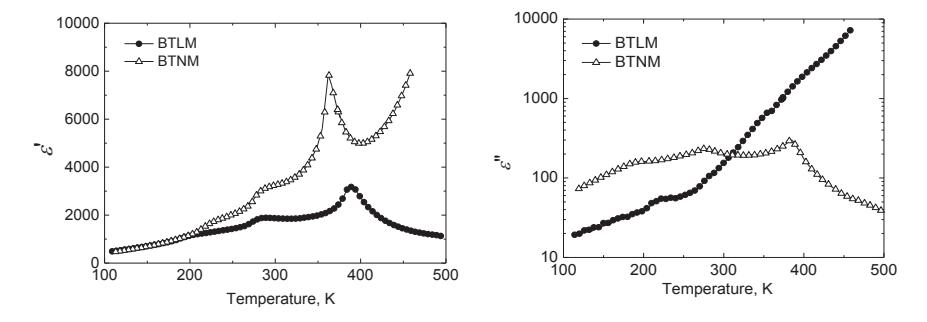
Barium titanate (BaTiO3) is the first ferroelectric ceramics and a good candidate for a variety of applications due to its excellent dielectric, ferroelectric and piezoelectric properties [1]. Doping of BaTiO3 with ions having a similar ionic radius could lead to structure and microstructure changes and furthermore modification of dielectric and ferroelectric properties. The possibility of easy substitution is enabled due to the capability of the perovskite structure to host different sized ions in the BaTiO3 lattice. Experimental process was given in detail in previous reports [2]. Doped barium titanate has found wide application in semiconductors, PTC thermistors, ultrasonic transducers and piezoelectric devices.
The dielectric properties of BaTiO3 with 0.3 mol% La and 0.05 mol% Mn (BTLM) and BaTiO3 with 0.8 mol% Nb and 0.1 mol% Mn (BTNM) were investigated in a broad frequency (20 Hz – 1 GHz) and temperature (100 K – 500 K) range. The investigations showed that the temperature dependence of complex dielectric permittivity is similar to pure barium titanate, however all temperatures of phase transitions differ in both materials.