
Anthracene derivatives with various substituents at different positions are in a great interest of today's science as a promising emissive material for blue organic light - emitting devices (OLED) [1]. Materials show high emission efficiency, colour purity and stability [2]. However, like other organic compounds, anthracene derivatives tend to crystallize in thin films and strongly deteriorate colour purity and efficiency of OLED device. Additionally, for inexpensive and efficient production of anthracene – based OLED devices it is necessary to improve solubility of these compounds in common solvents. A key of importance is to investigate the impact of substituents on optical and electrical properties of anthracene derivatives.
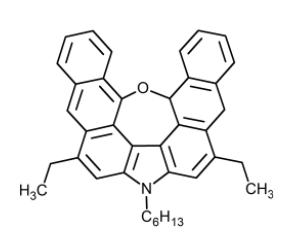
In this work optical properties of a set of asymmetric 3 – phenylanthracene derivatives with bulk phenyl, naphtyl, biphenyl, carbazole and benzoanthracene moieties at 9th and 10th positions of molecule were investigated. In addition to this, a newly designed 9H-carbazole and condensed system with two anthracene fragments, connected with additional heteroatom (NOP) (Fig. 1) was also optically characterised
Asymmetric anthracene derivatives with substituents at 9th, 3rd and 9th, 10th and 3rd positions show absorption and fluorescence peaks at 397/422 nm and 406/435 nm, respectively. Additionally phenyl substitute in 3rd position extends $\pi$-conjugated electron system. As the result, red shift in absorption and fluorescence is observed in comparison with unsubstituted anthracene. Anthracene derivatives with the bulk substitutes in 9th and 10th positions showed slightly increased fluorescence quantum efficiency (up to 48.6%) in comparison with derivatives substituted at 9th and 3rd positions (up to 42.6%) due to a faster radiative decay rate. Investigation of fluorescence QY in polystyrene matrix showed, that bulk substitutes in 9th and 10th position of anthracene disrupt planar geometry and fluorescence QY in thin film is up 13.2%. The investigation of radiative and non-radiative relaxation pathways reveals constant fluorescence non-radiative decay times, which implies a minor impact on intersystem crossing due to phenyl substitute introduced into 3rd position.
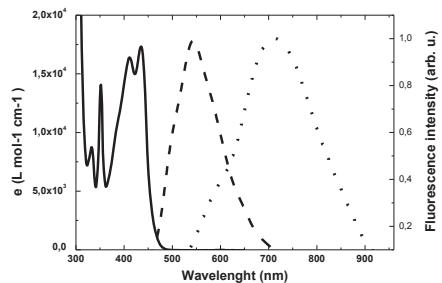
The detailed spectroscopic analysis of NOP compound demonstrated twofold absorption in dilute solution (Fig. 2). Vibronic series in absorption spectra at 411 nm and 435 nm which are also typical to unsubstituted anthracene derivatives and several narrow carbazole-specific bands (at 240 nm) were observed. Redshifted absorption spectra indicates extended $\pi$-conjugated electron system and planar geometry of the molecule. NOP compound demosntrates strong absorbance (17325 l mol-1 cm-1) and large Stokes shift of fluorescence of about 106 nm. A 173 nm redshift of the thin film fluorescence peak evidence eximer formation in the solid state. Nonexpontial decay in dilute soliution and thin films also confirms intermolecular interaction and competing exciton radiative relaxation and diffusion processes.