Carbon nanotubes (CNTs) exhibit a unique combination of excellent mechanical, electrical, and electrochemical properties which stimulate ever increasing interest in the application of CNTs as components in biosensors. The initial stage for the development of the DNA-containing biosensors is linking of a molecule of nucleic acid to the surface of CNT.
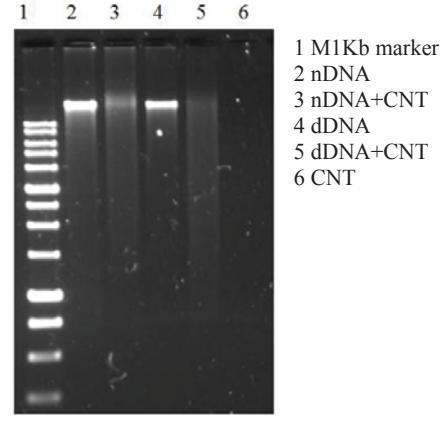
The interaction of native DNA (nDNA) and denaturated DNA (dDNA) with CNT was estimated by electrophoretic separation of the products from the DNA-CNT interaction (Fig. 1). DNA was revealed with the help of coloring by ethidium bromide; CNT was exhibited in gel as dark areas without an additional coloring. The ethidium bromide dye, being linked to DNA, is fluorescent in the UV spectral region, whereas linking to the DNA-CNT complex leads to lower fluorescence intensity of the dye due to fluorescence quenching as CNT is a universal quencher for different fluorophors [1].
Analysis of the electrophorograms for nDNA and dDNA complexes with CNT demonstrates that the fluorescence intensity at track 5 (Fig.1) is lower than that at track 3. Based on the data obtained, it is supposed that the complexation efficiency of CNT with dDNA is higher than that with nDNA.