Recently, light containing short-wavelength components became an object of debate due to the discovery of retinal intrinsically photosensitive ganglion cells that are sensitive to blue light. Blue-enriched white light is claimed to disrupt circadian rhythms and pose health issues even at low illuminance [1]. However in night-time conditions, the relevant luminances fall in the range of mesopic vision, where the luminous efficacy of blue-rich light sources increases with reducing adaptation luminance due to the shifting of the spectral sensitivity of vision to shorter wavelengths. This requires the optimization of the spectral power distributions (SPDs) of mesopic and photopic light sources.
Circadian action factor (1) (CAF) is a solid parameter for evaluating different light sources [2]. While linking CAF to the Kruithof curve [3], photobiologically friendly lighting can be achieved.
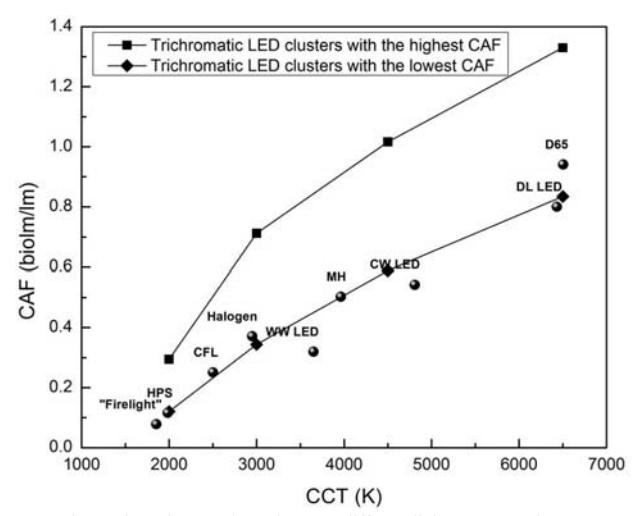
$$a_c = K_C / K = K_{c0} \frac{\int_{380nm}^{780nm} C(\lambda) S(\lambda) d\lambda}{K_0 \int_{380nm}^{780nm} V(\lambda) S(\lambda) d\lambda}\tag{1}$$In this work a comparison of the CAF of trichromatic light-emitting diode (LED) clusters having different correlated colour temperatures (CCTs) and common lamps is discussed. It was shown, that CAF can be varied up to 10 times using trichromatic clusters composed of the commercial LEDs (fig. 1).
Based on an optimization [2], a prototype of an optimal dichromatic solid-state lamp with extra-low colour temperature for street lighting was demonstrated. It consisted of a 20 phosphor conversion amber (597 nm) and 2 direct emission royal blue (455 nm) light emitting diodes with CCT at 1855 K.
Reaction time and Farnsworth-Munsell (F-M) 100 hue tests were performed comparing high pressure sodium (HPS) and extra-low CCT dichromatic ("firelight") lamp. It was shown up to 10% shorter reaction time and 20% improved F-M test score with "Firelight" lamp at mesopic 0.3 cd/m2 luminance.