LiVP2O7 and TiP2O7 are reported to be active cathode materials for applications in lithium secondary batteries. TiP2O7 belongs to cubic symmetry with the Pa \overline{3} space group. Its lattice is built up from corner sharing TiO6 octahedra and P2O7 groups which form large tunnels for migration of lithium cations [1]. The purpose of this work is to investigate electrical properties of TiP2O7 compound when lithium is initially inserted into the host compound during the synthesis.
The powder of Li4xTi1-xP2O7 (x = 0.06, 0.1) compounds were synthesized by solid state reaction. X-ray diffraction (XRD) analysis shows that these compounds are isostructural with TiP2O7 compound at room temperature. The results of XRD analysis are presented in Table 1.
| Compound | Lattice parameters a, Å | Lattice parameters V, Å3 | Symmetry (space gr.) | Formula units Z | Theoretical density ρXRD, g/cm3 |
|---|---|---|---|---|---|
| Li0.24Ti0.94P2O7 | 23.6247 | 13186 | cubic | 100 | 3.00 |
| Li0.4Ti0.9P2O7 | 23.6245 | 13185 | (Pa 3) | 108 | 2.99 |
The powders were pressed into pellets. The pellets of compounds with different stoichiometric factor x = 0.06 and 0.1 were sintered at 1373 and 1273 K temperature respectively. Two different sintering durations of 1 and 5 hours were chosen. The relative densities of the sintered ceramics were from 74 to 86%.
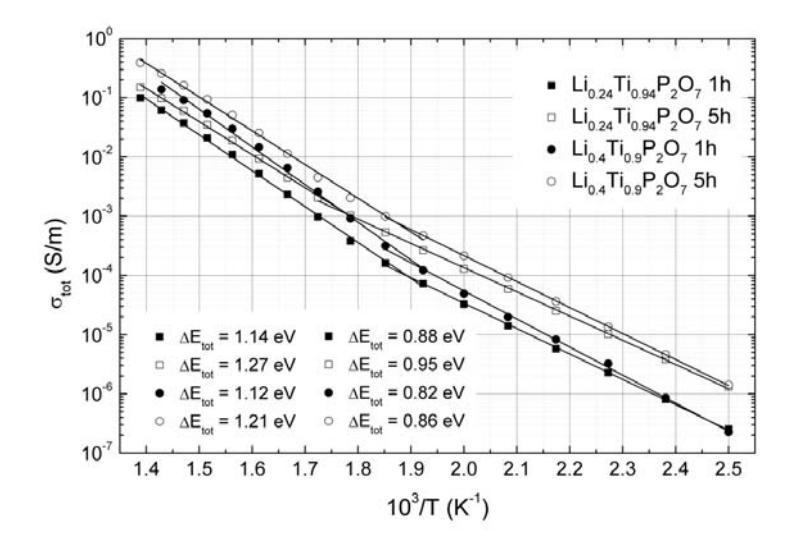
Electrical properties (dielectric permittivity, tangent losses and electrical conductivity) of the ceramics were investigated by two probe methods in two frequency ranges: $10 - 2 \cdot 10^6$ Hz and $10^6 - 3 \cdot 10^9$ Hz [2]. The anomalies of electrical conductivity are observed and lead to the changes of activation energy of electrical conductivity. The temperature dependence of electrical conductivity is showed in Fig.1.