
The speed at which electromagnetic waves travel through vacuum is constant, and equal to 3 x 10⁸ ms-1. However Earth's atmosphere is not vacuum, it is composed out of a gas mixture, where 78 % is nitrogen, 21 % is oxygen, 0.9 % is argon, 0.03 % is carbon dioxide. These gases slightly changes radio wave propagation through atmosphere, which in turn can affect their transmission quality from the transmitter to receiver. Radio wave propagated through the earth's atmosphere encounters variations in the atmospheric refractivity index along its trajectory that causes the ray path to become curved. At standard atmosphere conditions near the earth's surface, the radio refractive index, N, has a value of approximately 1.0003 [1]. The atmospheric radio refractive index n can be calculated using Eq. (1):
$$n = 1 + N \times 10^{-6} \tag{1}$$Radio refractivity is used to simplify the values and make them more manageable. The refractivity is a dimensionless parameter, expressed by:
$$N = A \left( p + B \times \frac{P_v}{T} \right) / T \tag{1}$$Where p is atmospheric pressure (hPa), $P_v$ is water vapor pressure, and T is absolute temperature. A = 77.6 K/hPa and B = 4810 K. For frequencies up to 100 GHz, the error is less than 0.5%.
We propose a model on how to calculate atmospheric refractive index in any location on the map (Fig. 1). Only locations coordinates, height above sea level and temperature must be known. Some locations are used as a reference points for the model. These locations are Vilnius, Kaunas, Klaipėda, Panevėžys, Šiauliai, Kybartai, Pagėgiai, Telšiai, Utena and Alytus, where metrological data about temperature, relative air humidity and atmospheric pressure is measured a few times a day. These parameters are used to calculate radio wave refractivity in these locations.
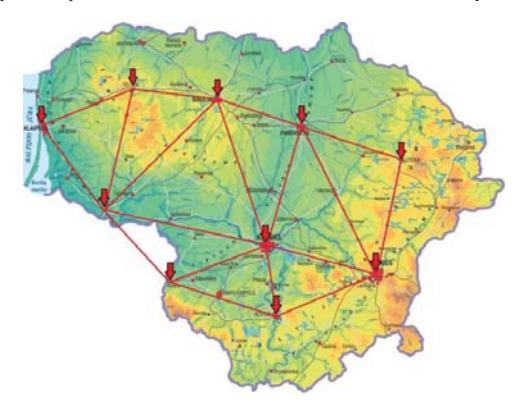
Refractivity values in the location on the map other than the reference points, according to the proposed model, can be calculated directly from known refractivity values in the mentioned cities or from othermetrological data. This makes the proposed model very flexible and more accurate.
By testing and analyzing the model few conclusions are made. First – the use of relative humidity monthly averages can sometimes lead to wrong refractive index values. Second – model is capable of calculating radio refractive index with good accuracy, when primary weather parameters are correct.