Second harmonic generation (first time demonstrated by P.A. Franken [1] in 1961) is a well-known process which is widely used for effective frequency conversion in laser systems, pulse duration measurements etc. There are two cases of SHG process realization : collinear and noncollinear. Noncollinear second harmonic generation has a few advantages. The beam directions of fundamental and second harmonic waves are spatially separated behind the crystal, therefore no additional filtration of radiation is required. Additional filtration using either filters, dichroic mirrors or diffractive/dispersive optical elements usually leads to energy losses so noncollinear SHG technique offers a potentially higher frequency conversion efficiency. It is especially important while generating higher (for example 4th) harmonics because of the formation of colour centers in transparent condensed medium by UV radiation. The other reason to use noncollinear SHG is a possibility to use pump radiation from two separate laser sources [2]. Using two separate laser sources as a pump for SH generation enables to reach higher pump energies. It is important because the pulse energy of an energy source is limited by maximal pulse intensity in a laser medium. Larger active elements must be used to increase output pulse energy. This causes additional problems: inhomogeneous pump beam, thermal management of active medium, etc. So using two energy sources as two pump beams for SHG allows to reach higher SH pulse energies and better conversion efficiency.
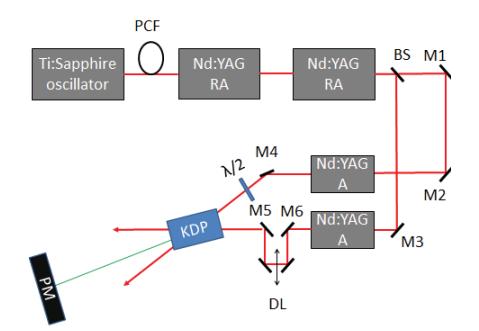
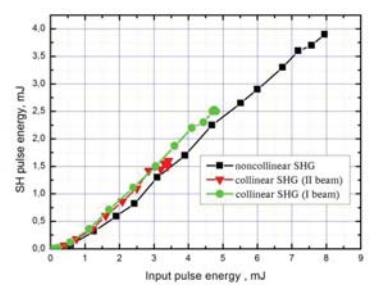
During this work KDP (KH2PO4) type-II 4 cm length crystal was pumped by two separate laser sources (each beam had up to ~4 mJ pulse energy, ~75ps pulse duration and repetition rate of 1kHz), see Fig. 1 for details. Using configuration of noncolinear SHG with angle of 5.7 degrees between the pumping beams an effective frequency doubling (up to 49%) with generated SH pulse energy of 3.9 mJ was demonstrated (see Fig. 2).