
The multiwave interactions in media with thermal nonlinearity offering the possibility for transformations of the characteristics of laser radiation (phase, polarization, topological charge, etc.) are of great interest for the researchers and technologists.
To realize four-wave mixing (FWM), two beams, reference and signal, were directed at a small angle into a nonlinear medium to record a dynamic hologram. Reading of the hologram was performed by the beam directed precisely to meet the reference beam, the diffracted beam formed with a wavefront identical to that of the signal beam was propagating in the counter direction, and the phenomenon of wavefront conjugation was the case [1].
A nonlinear medium was represented by ethanol solution of the Rhodamine 6G dye. The experimental wavelength of laser radiation used (532 nm) was falling within the absorption band of this dye. Thermal nonlinearity was exhibited due to absorption of the pulsed radiation and local heating of the solution. During the experiments the nanosecond laser pulses had the repetition rate 10 Hz at the mean power of laser radiation 50 mW.
The main objective of this work was to establish optimum concentrations of the Rhodamine 6G dye solution in ethanol upon FWM with the use of Gaussian and singular light beams varying their intensities.
Fig. 1 shows the experimental results obtained.
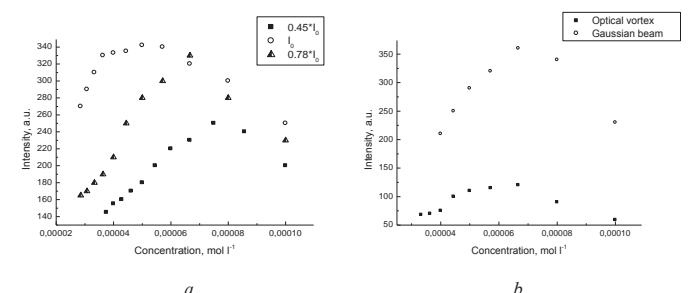
In Fig. 1, a it is seen that the diffraction efficiency is lowering as the signal wave intensity decreases, probably due to lower absorption of the energy and lower heat release. In the process an optimum concentration of the solution is growing. At the same time, the use of different signal waves (Gaussian and singular) has no significant effect on the optimum concentration that is about $6.7 \times 10^{-5}$ mol·l-1. It should be noted that the efficiency of FWM for a Gaussian signal wave is higher than that of the singular one. Higher interaction efficiency for the Gaussian signal beam is caused by the use of Gaussian reference and reading waves, making it possible to realize effective overlapping of all these three Gaussian light beams within the nonlinear medium volume. When an optical vortex is used as a signal wave, the region of a maximum Gaussian-beam intensity falls within the region with a minimal intensity of the optical vortex to result in lowering of the interaction efficiency.
Based on the conducted experimental studies, optimum values of the concentration for the Rhodamine 6G dye solution on FWM with the use of Gaussian and singular light beams as a signal wave have been determined