Cold and dense molecular hydrogen clouds serve as Galactic stellar nurseries. Stars are thought to form from dense molecular cores embedded deep within such clouds. What processes counteract the turbulence, which dominates the cloud, initiates collapse and trigger star formation? Several models have been proposed [1]. In this work we investigate if collapse of molecular clouds can be initiated and/or enhanced by external pressure of hot ISM (interstellar medium) surrounding the cloud. Numerical models of molecular clouds enable us to explore deep interiors of such structures, simulate processes that occur during collapse. This information is crucial for our understanding of dynamical processes with timescales much longer than human lifetimes that contribute to star formation.
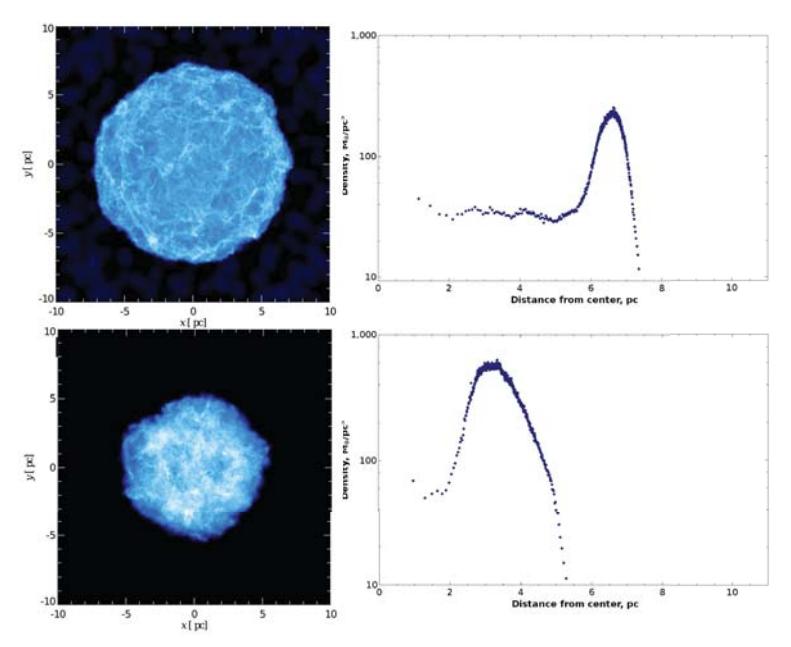
Numerical SPH/N-body models were employed to simulate the dynamical evolution of such systems, using the Gadget code [2]. Static, homogenous models of molecular clouds supported by turbulence were embedded in hot ISM of various temperatures. We found that 107K temperature and 1cm-3 density ISM is sufficient to compress the cloud and initiate collapse. Collapse of such system creates a shock wave propagating inwardly, towards the center of the cloud. The shocked gas is compressed 4-5 times; such a dense environment enhances formation of gravitationally bound structures.
It was shown that models with highest ISM temperature form gravitationally bound structures fastest, most of gravitationally bound clumps in such models form within the propagating shock wave. Models with ISM temperature value that would keep cloud and hot ISM in equilibrium form gravitationally bound clumps in a shell around the cloud. Finally, models that were embedded in ISM colder than necessary to maintain equilibrium were disrupted and gravitationally bound structures formed in such conditions were only a consequence of turbulence.