
We present results of investigation of the effect of molecular orientation, which affects the charge transport characteristics of vacuum deposited organic amorphous films. The electrical and optical properties of the thin films based on derivatives of diphenylethenyl substituted triphenylamines (TPA) were investigated (structural chemical formulas are presented in Figure 1). The samples for optical and electrical measurements were prepared using vacuum deposition on glass and on ITO/glass substrates, respectively, in a vacuum of $7\cdot10^{-3}$ Pa at the evaporation rate 1.3 nm/s. The spectroscopic ellipsometry measurements were performed using a fast spectroscopic ellipsometer RC2 (J. A. Woollam Co., Inc.) in the 0.73 – 6 eV spectral range at seven different angles of incidence in the $45^{\circ}-75^{\circ}$ interval in steps of $5^{\circ}$. At each incidence angle, experimental ellipsometric parameters $\Psi$ and $\Delta$ were simultaneously recorded. The values of $\Psi$ and $\Delta$ did not change by rotating the samples, indicating that films had no in-plain anisotropy. An analysis of the data was carried out using the software CompleteEASE (J. A. Woollam Co., Inc.), which can perform a batch analysis of all data for all incident angles and wavelengths. The dielectric function of the system was extracted by the b-spline [1] mean square error (MSE) [2] technique. The spectra of optical parameters determined satisfy the Kramers-Kronig relations.
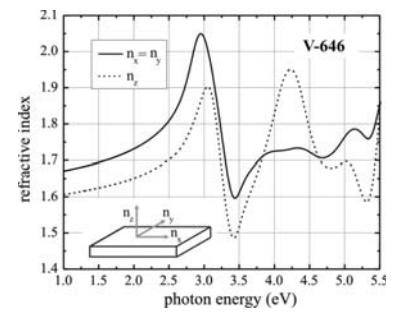
The experimental ellipsometric parameters of the organic films first of all were simulated using an isotropic model. The simulation yielded satisfactory results of MSE = 3 for the TPA films V-609 and V-645, which have single CH3 unit attached. However, an isotropic model failed to simulate (MSE = 24.3) experimental data of the V-606 and V-646 films, which don't have CH3 groups. The attempts to simulate ellipsometric parameters with complicated models of a non-uniform refractive index within the film and assuming the interface layer in-between the substrate and TPA layer have not compensated the deviation. The ellipsometric parameters of the V-606 and V-646 films could be well simulated only by a uniaxial anisotropic model. Good agreement between simulated and experimental parameters using uniaxial anisotropic model was proved by small MSE value of 3.2. The analysis reveals anisotropy in the V-606 and V-646 films. The deduced anisotropic refractive indices of organic layer V-646 are presented in Figure 2.
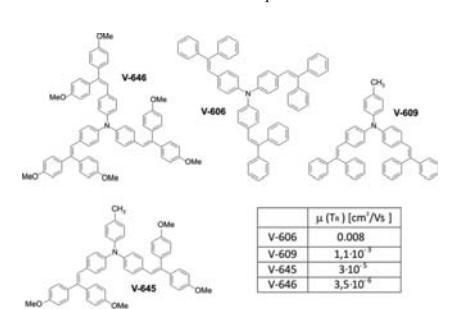
We investigated the effect of the horizontal molecular orientation on the hole mobility by performing time-of-flight (TOF) measurements. Inset in Figure 1 shows the measured TOF mobilities of holes in the TPA films deposited on polycrystalline TTO/glass substrate. The highest mobility, of $0.8\cdot10^{-2}\text{ cm}^{2}/\text{Vs}$, was estimated in the V-606 layers, what, we assume, is first of all due to horizontal molecular orientation in the amorphous film. If the V-606 layer is modified by changing one of its functional groups with the CH3 attachment (V-609), the hole mobility decreases by 7 times and the deposited layer becomes isotropic. When V-606 is modified by attachments of MeO groups (V-645 and V-646), the horizontal molecular orientation manifests itself in optical spectra only in V-646 layers, however the hole mobility decrease by ca. 2000 times.