Photosynthesis is a process in which light energy is captured and stored by an organism. Plants use water and carbon dioxide to produce carbohydrates and oxygen. This reaction is driven by light captured from the Sun. Inside chloroplasts various various pigment-protein complexes participate in this reaction. The first steps in the process is done by photosystem II (PSII), which oxidizes water to molecular oxygen [1]. The reaction center (RC) of the PSII uses light energy to perform the initial charge separation, a prerequisite for water oxidation.
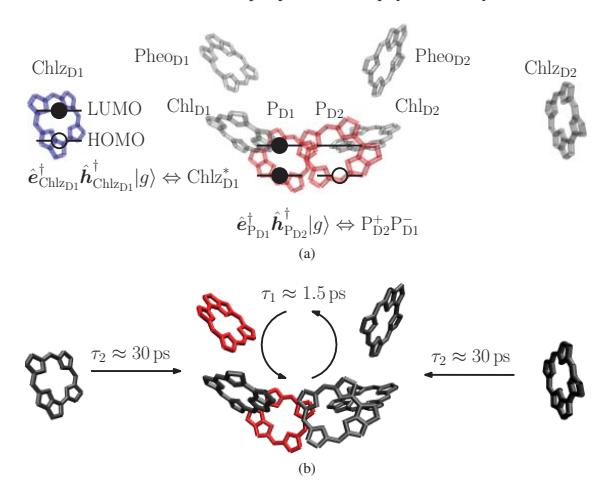
In this work we present a model of PSII RC based on the tight binding framework [2], which consistently describes both molecular excitons and charge transfer states. Our model is illustrated in Fig. 1a. It is derived from the modeling of experimental two dimensional optical spectra at 77 K [3]. Simulations based on our model captures all the main experimental feature present in the experimental data: the peak pattern, the lineshapes and time traces. This is achieved by including two charge separation pathways and correlations of both static disorder and fast fluctuations of the energy levels of charge transfer states.
Using our model, we calculate evolution of the states of the PSII RC. We find two timescales of charge separation (see Fig. 1b) at 77 K. Fast component $ \tau_1 \approx 1.5 $ ps is assigned to energy equilibration in core pigments and slower component $ \tau_2 \approx 30 $ ps is assigned to excitation transfer from the peripheral chlorophylls to the system core.