The assembly of proteins into amyloid-like fibrils has been studied extensively. A key to control protein aggregation is understanding its mechanism. The "nucleation-elongation" model has been suggested to explain fibril formation [1]. First of all, the nucleus must occur, but once it is formed the elongation process starts. The process of elongation has been noticed to be similar to an enzymatic reaction [2]. In this case the formed nucleus acts as an enzyme while monomers and/or oligomers act as substrate. Though, due to the complexity of amyloid-like aggregation, the degree of similarity is not clear.
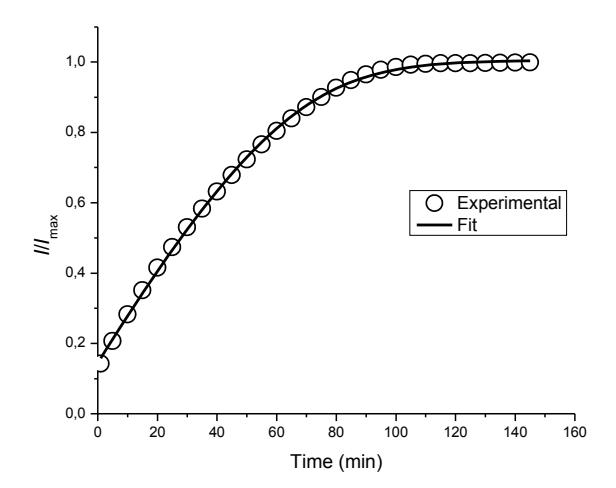
We tried to design experimental conditions in the way to ensure the only process going in our test tube during the measurement is fibril elongation via attaching monomers to fibril ends. In this case we can schematically describe the process as $F + M \rightleftharpoons FM \rightarrow F$, where F stands for fibril end, M – monomer, and FM is short-living complex, which exists from the time monomer attaches to the fibril and until it's completely incorporated. It reflects the enzymatic reaction scheme thus we were able to apply the Michaelis-Menten equation to fit fibril elongation kinetics (Fig. 1).
Excellent correlation with experimental data ($r^{2}_{adj} > 0.999$) and proposed model supports the possibility to describe the fibril elongation process as Michaelis-Menten kinetics event.